


.svg)
.gif)

Why Hibiki waited until 2026 to launch a global campaign
The Hibiki brand has built prestige through decades of craftsmanship and culture, only now stepping up to a global marketing platform. Hibiki is finally making a splash with its first-ever worldwide campaign - but the timing is no accident. This quietly premium whisky has traditionally relied on scarcity, high scores and word-of-mouth among collectors, rather than loud advertising, to build its reputation.
By 2026, Hibiki no longer needed to convince consumers that Japanese whisky belonged in the luxury conversation. The brand had already earned global recognition through decades of craftsmanship, critical acclaim, and growing demand for premium Japanese spirits. Rather than continue with education-focused marketing that explained what Hibiki is, Suntory saw an opportunity to elevate the brand into something larger: a cultural icon. In our work with premium spirits brands, we see this shift across the luxury landscape. Today's consumers are drawn less by technical specifications such as age statements or ABV and more by emotional resonance, cultural credibility, and the stories behind a brand. Hibiki's leadership recognized that the brand's heritage, prestige, and cultural equity had matured enough to support a narrative-driven global platform.
Hibiki's global profile has been quietly established over years. Suntory notes Hibiki has been produced since 1989, and the brand famously appeared in the film Lost in Translation - evidence that it was already a recognized name in popular culture. Suntory itself underscores that it's the founding house of Japanese whisky, with Hibiki embodying the blending of Yamazaki, Hakushu and Chita distilleries. By 2026, the Japanese whisky category has won enough awards and acclaim that basic education isn't needed - global drinkers understand the idea of Japanese whisky. Hibiki waited until now to take the lead because the market has matured and consumers are ready for the story behind the whisky, not an introduction to the liquid itself.
Hibiki's strategic timing reflects both confidence and necessity: confidence that its brand equity was strong worldwide, and necessity because the broader spirits market is tightening and competing on narrative and authenticity rather than price or promises. Our view is that at a time of consumer caution, premium spirits can no longer rely solely on age statements, scarcity or high prices to justify luxury pricing - they need brand meaning. That shift helps explain why Suntory waited until Hibiki had a global audience primed for its cultural message.
From Product Advertising to Cultural Authority
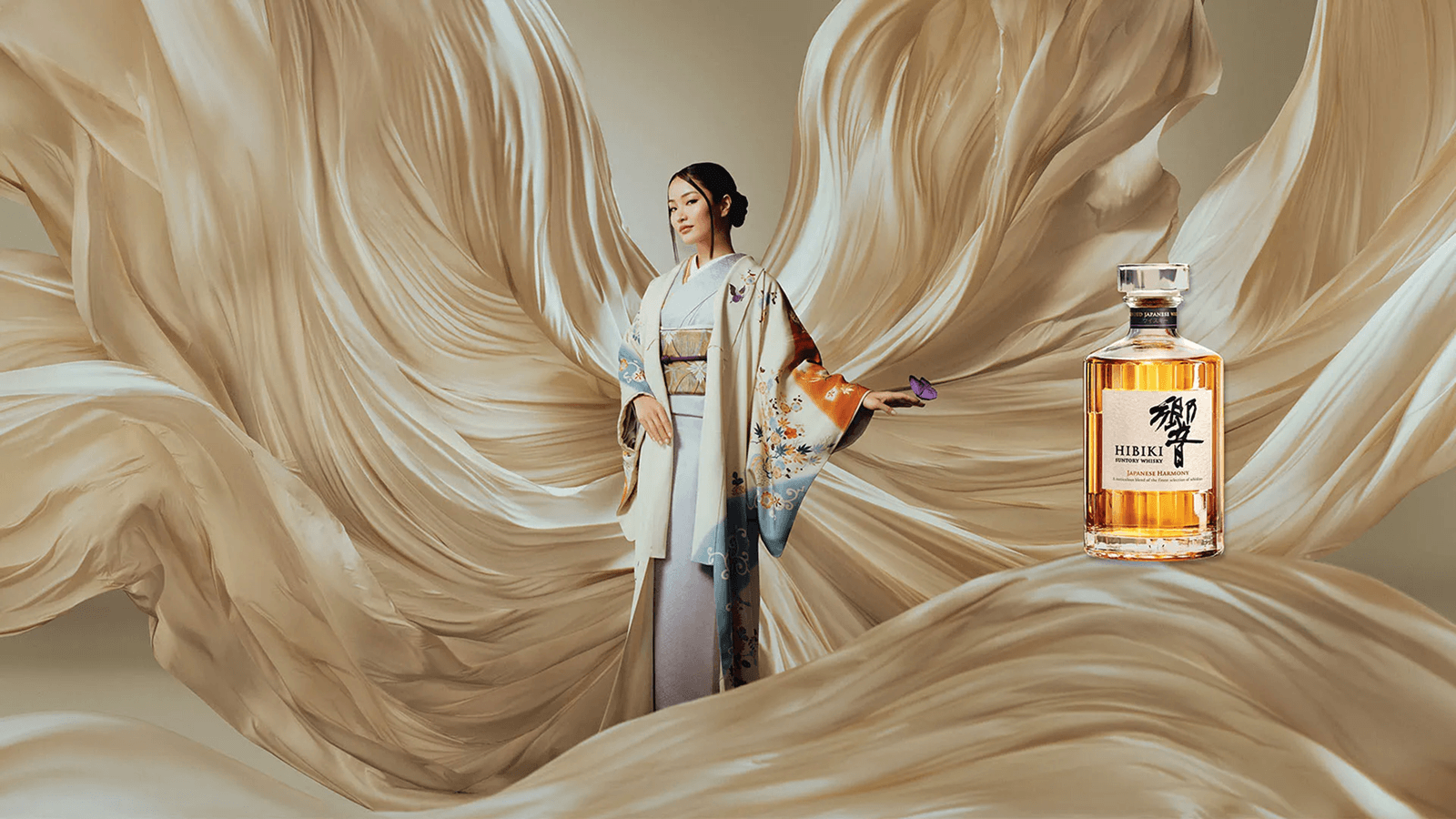
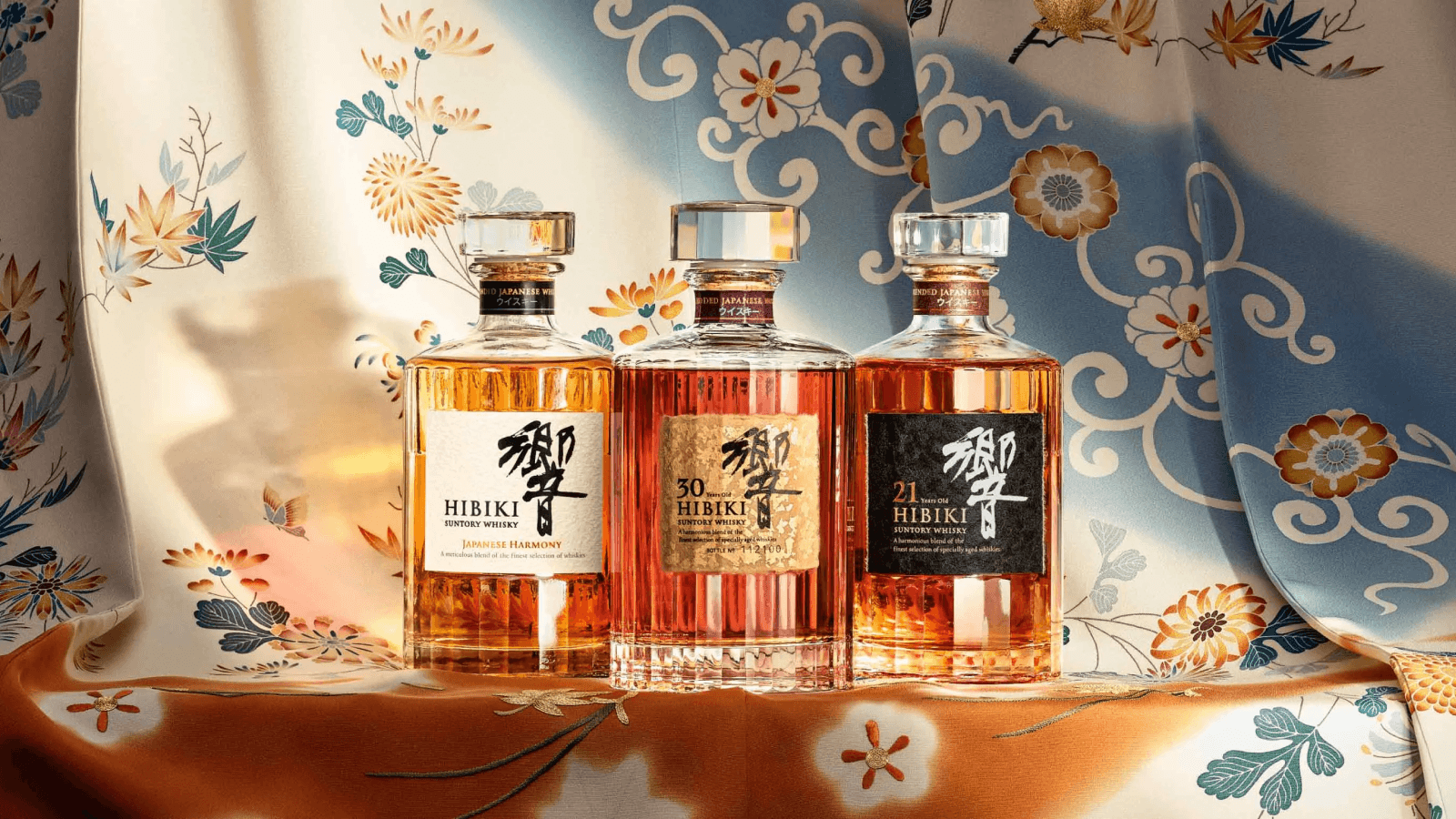
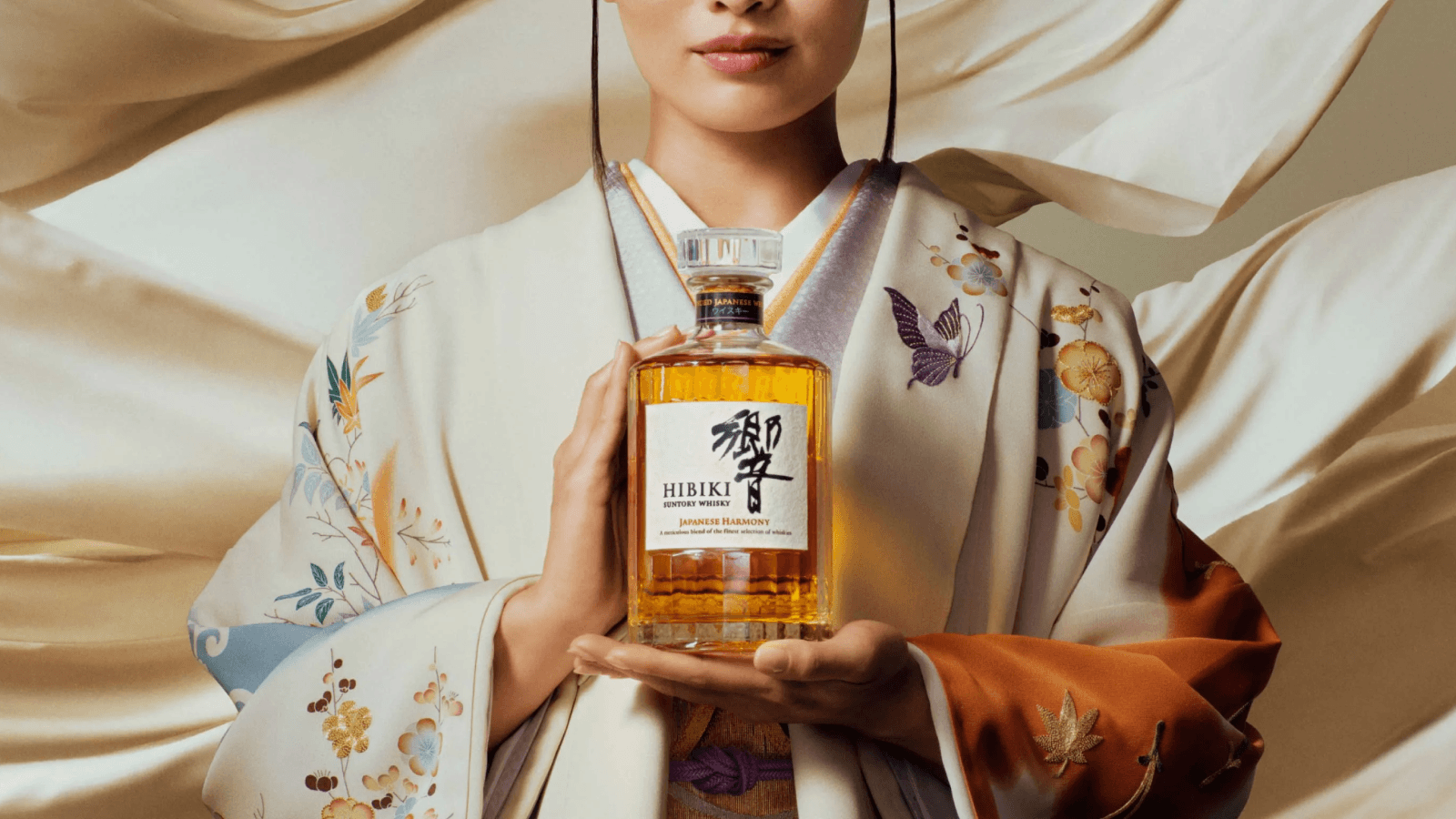
Hibiki's new campaign shifts the message dramatically: the whisky is now framed as a contemporary expression of Japanese culture, not just a drink. Suntory's materials make this explicit. The campaign is called "The Masterpiece of Japanese Artistry," and it invites consumers to experience key elements of Japanese culture through whisky, nature and contemporary artistry. In practice, the hero film makes visual and philosophical parallels between whisky blending and kimono-making, washi paper and seasonal nature. Instead of explaining what Hibiki tastes like, the ads unfold like a luxury film: viewers see an embroidered kimono unfurl, a purple butterfly motif (the color of Hibiki's logo) drifting over silk, water cascading into a cask. The effect is more museum exhibit than liquor ad. The campaign anchors Hibiki in tangible symbols - the 24-faceted bottle, the hand-made washi label, the noble purple band - all of which carry real meaning. The result feels, to us, less like advertising and more like cultural curation.
This pivot reflects a broader luxury trend. Whereas a generation ago spirits ads might brag about age statements or flavor, today Hibiki sells artistry and harmony. Suntory's president says they cast an actress who shares the same reverence for Japanese artistry - language you'd expect in a museum, not a whisky commercial. In line with that, Hibiki's new marketing is almost hermetic: it assumes consumers already know it's a top-tier whisky, so it focuses on why the brand matters culturally. In short, Hibiki is positioning itself not just as a whisky brand, but as a symbol of Japanese craftsmanship - a shift we are seeing more often in premium spirits as brands invest in cultural capital (story, symbolism, identity) rather than product credentials.
The Anna Sawai Strategy: Building Modern Asian Luxury Codes
In a break from whisky tradition, Hibiki's first global face is actor Anna Sawai - a young Japanese woman with a truly international career. Suntory's leadership explains they wanted someone rooted in Japanese heritage yet shaped by a global career, and Sawai fits that description. She won an Emmy for Shōgun and stars in global projects like Pachinko, but she has also embraced Japanese artistry (including recent Dior and Cartier work). This makes her an ideal bridge: she brings international recognition while still feeling culturally aligned with the campaign's Japanese artistic narrative. In other words, she embodies modern Asian luxury: a cosmopolitan figure who still represents Hibiki's heritage.
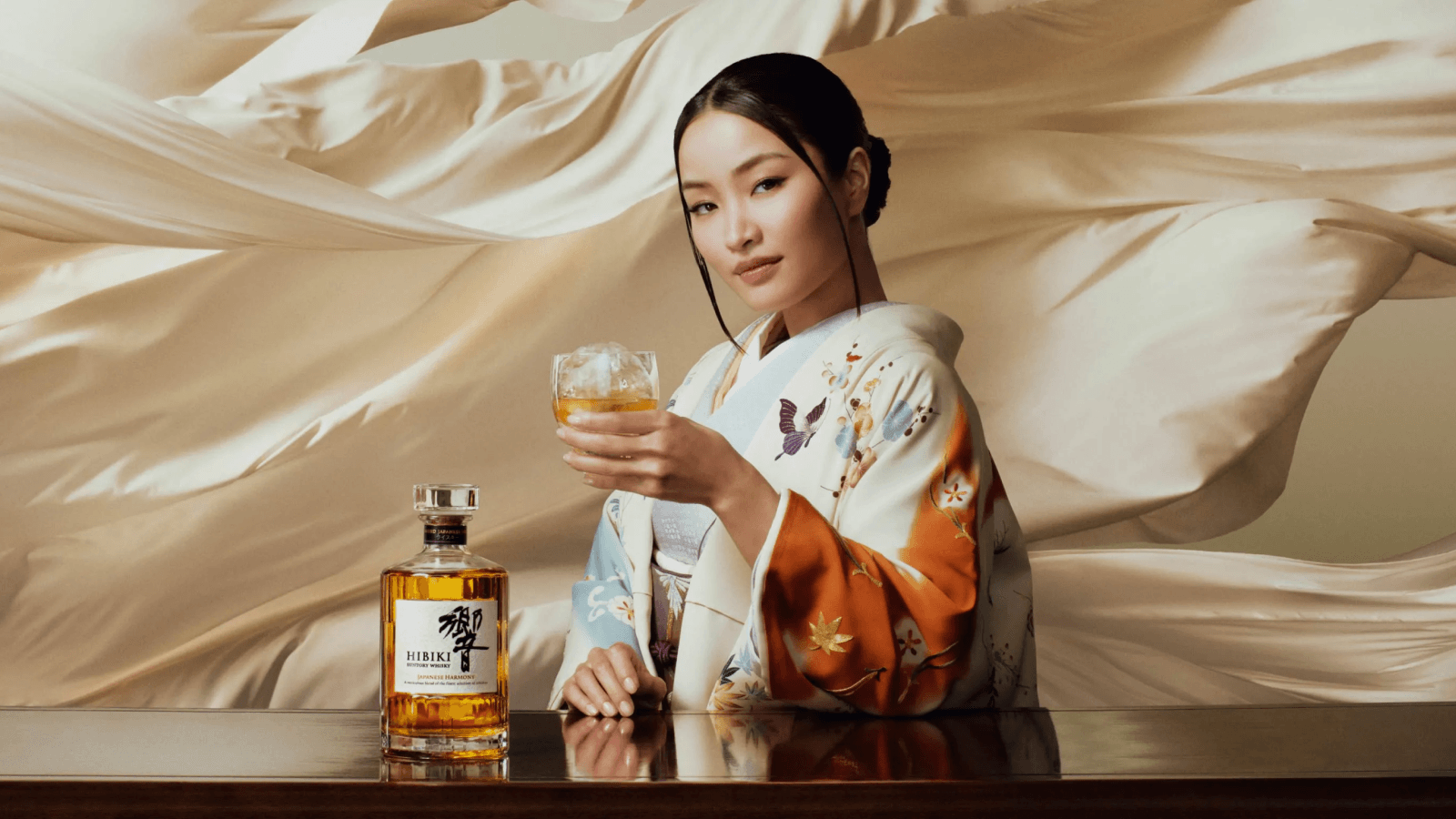
From our own celebrity and ambassador work, the most important distinction in this kind of casting is between an ambassador as decoration and an ambassador as translator. Most brands get this wrong - they buy fame, attach it to a bottle, and assume equity transfers. It rarely does. A translator-ambassador does something harder: they explain the brand to an audience that doesn't yet know it, in a register that audience trusts. The casting is judged not by the ambassador's fame but by whether they can carry the brand's worldview without distorting it. Sawai is cast as a translator, and the campaign architecture supports it: she appears wearing the Chiso kimono, observing washi papermaking, framed inside the brand's story rather than in front of it. Her own words reinforce the role: she says Hibiki represents a quiet kind of mastery, refined over time with care and intention, and that she and the brand share the same philosophy of craft. That's a translator's language, not a decorator's.
Why the Chiso Partnership Matters More Than the Whisky Itself
The centerpiece of the creative campaign is a bespoke kimono from Chiso, a Kyoto house founded in 1555. This is not a random celebrity collaboration - it's a heritage partnership that lends immediate credibility. Chiso's centuries-long legacy of silk craftsmanship and yuzen dyeing aligns directly with Hibiki's own values of patience and artistry. We consider the Chiso tie-in the campaign's most strategically important move. By showcasing the kimono in every spot (and planning a Chiso kimono exhibition at JFK), Suntory weaves Hibiki directly into the fabric of Japanese art.
This kind of collaboration teaches a lesson we apply constantly in our own brand-building work: authenticity can't be faked, and the test of a heritage partnership isn't whether it sounds prestigious. The question we ask when advising heritage-led brands is whether the partnership survives the trade conversation - can a bartender, buyer or sommelier explain in one sentence why the partnership matters to the liquid in the glass? Chiso passes that test cleanly. Dyeing and blending share genuine craft logic: layering, restraint, time, the refinement of materials into something more than their parts. A bartender can say that. Most luxury collaborations in spirits don't pass this test - they pair prestige with prestige and hope the consumer connects the dots. Hibiki's campaign works because Japanese artistry is not an overlay added for global audiences; it is the foundation of the brand itself. Suntory has invested in this authenticity for years (think Hibiki's handcrafted washi labels and limited-edition artist series), so the Chiso partnership feels like continuity, not a one-off stunt. The lesson for alcohol brands is to build deep partnerships with cultural artisans - whether it's a whisky with a native grain distiller or a gin with a botanical garden - so that every collaboration reinforces genuine heritage rather than just grabbing headlines.
The Cinematic Luxury Playbook Replacing Traditional Spirits Advertising
Hibiki's ads look and feel more like a fashion film than a liquor commercial. In each frame the production values are high-end: dramatic slow motion, rich textures of silk and wood, natural lighting and an orchestral score. This is deliberate. Suntory's cinematic short film explicitly draws parallels between whisky blending and kimono-making - two crafts shaped by patience, precision, and time. There are virtually no product shots or technical bullet points. Instead, the focus is mood and metaphor: we see the craftswoman's hands and Sawai's flowing kimono, not glasses or logos. This editorial aesthetic is by design. Many premium spirits ads rely on grand visuals but fail to connect them to the product; in our reading, Hibiki's campaign avoids that trap by rooting every symbol in the whisky's real story. The effect is that we remember a feeling, not a specification.
This trend is growing in luxury spirits marketing. Leading brands are increasingly adopting editorial and cinematic styles borrowed from high fashion and film advertising. Hibiki's spot is a prime example: it could sit alongside a Gucci or Dior short film on YouTube, complete with its own hashtag (#TheMasterpieceOfJapaneseArtistry). For industry leaders, the signal is that future campaigns must be content-rich experiences, not just product pitches. High-quality narrative videos (and even branded documentaries or art installations) engage premium consumers more deeply than listing ABVs. In short, Hibiki shows that in 2026 a whisky ad needs to be as artful as the liquid's own story.
Turning Craft Into Scalable Global Storytelling
Suntory is taking inherently Japanese elements (kimono, washi paper, seasonal imagery) and scaling them into a message meant for New York, Shanghai and beyond. The campaign launches across more than 15 markets including the US, China, UK, France, Germany, India, Singapore and Australia, with the clear ambition of making Hibiki a global luxury icon tied closely to modern Japanese artistry. To make this work, the narrative emphasizes universal themes in the craft: nature's cycles, harmony (the concept of wa), and the human passion behind creation. For example, a behind-the-scenes video explains that Hibiki's bottle has 24 facets - representing Japan's 24 seasons - tying a local tradition to a broader fascination with time and ritual. By focusing on emotion and symbolism, Suntory has given international audiences a way in.
At the same time, Hibiki's strategy embodies a current tension in global branding: preserve specificity without alienating. Modern luxury marketing teaches that homogenization is weakening. Increasingly, the campaigns that resonate are those that feel rooted in a specific place, philosophy or craft tradition rather than generic minimalism. In Hibiki's case, the rollout refuses to soften its Japanese identity for a Western crowd. This is a calculated bet: cultural specificity is now seen as an advantage. The risk is real, however. The true test for Hibiki, in our view, will be maintaining the delicate balance as it expands. If the campaign's execution isn't disciplined, global promotion can flatten a distinctive brand into generic "premium lifestyle" messaging. In other words, Hibiki must not become a louder, broader brand just to appeal everywhere. Early signals are promising - by keeping the craft at the core, Suntory hopes Hibiki will scale its cultural storytelling without losing the authenticity that made it special.
Why JFK Airport Became Part of the Campaign Strategy
A telling move in Hibiki's launch is the planned kimono exhibition at New York's JFK Airport. Suntory isn't treating travel retail as a passive distribution channel - it's treated it as a marketing platform. House of Suntory and Chiso will install the Hibiki kimono art inside the new luxury concourse of Terminal One. This places the brand directly in front of well-heeled, international travelers in a highly curated environment. Airports are increasingly evolving into premium brand theaters. Affluent travelers often wander airport boutiques leisurely, in celebratory or aspirational mindsets (holiday shopping, gift-hunting). By staging an artful kimono display, Hibiki meets consumers in that emotionally charged context.
This approach to experiential branding is significant. Hibiki fits naturally into the airport ecosystem because its value proposition is experiential and symbolic, not purely functional. In short, the whisky's appeal is in its story and aesthetic, which can shine in a sleek travel setting. Suntory is leveraging this by engaging multiple senses: visual (the kimono, ambient lighting), cultural (Japanese motifs in an international hub), even tactile (viewers can walk among the kimonos). By contrast, most spirits brands still view an airport as just a place to stock bottles on shelves. Suntory's view - treating JFK's terminal as a multimedia brand showcase - reflects a new premium trend: make the point of sale an experience, not just a checkout. For brand owners, the takeaway is that high-end travel hubs and other luxury venues (hotels, museums, fashion precincts) can be powerful extensions of your brand story - especially when the audience is primed to value that story.
The Rise of Multi-Sensory Brand Worlds in Spirits Marketing
Hibiki's campaign paints a holistic brand world by weaving together images, sounds and textures. This is evident in every detail. The bottle itself becomes part of the narrative: its 24 facets (seasons), the handmade washi paper label, and the royal purple band are all highlighted in campaign materials. The behind-the-scenes content further immerses consumers in craft: one short film follows Eriko Horiki hand-making Hibiki's washi labels, complete with the sound of water dripping onto pulped paper; another takes viewers inside Chiso's atelier, where silk is dyed and folded. These multi-sensory vignettes tie directly back to the whisky - for example, watching ink spread on silk feels analogous to flavors blending in a cask.
We'd describe Hibiki as a case of vertical storytelling integration. That means every touchpoint - liquid provenance, bottle design, packaging, craftsmanship, partnerships, even how the ambient music is chosen - reinforces the central idea of balance and artistry. In practice, this makes Hibiki's world feel immersive: it's not just an ad or a tasting, it's a mini ecosystem. For the consumer, it's an experience on multiple levels: visually (kimono and scenery), aurally (music and natural sounds), and tactilely (the idea of silk and paper). Modern premium spirits campaigns are moving toward these multi-dimensional ecosystems because they help build deeper emotional connections than a single poster or product spec ever could.
Our Three-Question Framework - and One Prediction
When we evaluate luxury spirits campaigns at OhBEV, we run them against three questions. Does the campaign survive the trade conversation - can a bartender, buyer or sommelier explain why it matters in one sentence? Does it survive scale without dilution - can it cross 15 markets without flattening into generic premium messaging? And does it survive without the celebrity - if the ambassador walked away tomorrow, would the brand world still hold together?
Hibiki passes the first cleanly: the Chiso parallel between dyeing and blending is one sentence a bartender can deliver and a customer will remember. It attempts the second - the discipline is right, but the execution risk is real across 15 markets, and we'll only know in twelve to eighteen months. The third question is the open one. Sawai is cast as a translator, not a decorator, which is the right architecture; but architecture is tested under stress, and the campaign's durability without her remains the genuine unknown.
One forward-looking view we'd put on the record: the next premium spirits campaigns will copy Hibiki's Chiso move and most will get it wrong. The two tells to watch for are these. First, the partnership will be announced before the strategic role is defined - heritage partner first, "why" second. Hibiki did the opposite, and that ordering shows in the work. Second, the partner's craft will have no genuine analog in the liquid itself. Chiso/Hibiki works because dyeing and blending share real craft logic - layering, time, restraint. A whisky-times-watchmaker tie-in, for example, often doesn't. When you see partnerships that fail either test, you're seeing prestige-pairing rather than craft alignment.
Key Takeaways for Alcohol Brand Owners and Marketing Leaders
Integrate every element into a single brand story
Hibiki succeeds through vertical integration: the liquid, bottle design, labels, partnership and advertising all reinforce one core idea of Japanese artistry. Leaders should ensure their product's provenance, packaging and messaging all connect coherently, so each campaign touchpoint strengthens the same narrative.
Invest in authenticity over artifice
Real heritage only works when consistently reinforced. Hibiki's campaign feels genuine because Suntory has long woven Japanese craft into the brand (washi labels, limited editions), not just for this ad. Brands should build credibility by aligning with true artisans and cultural practices, not by attaching unrelated luxury imagery.
Embrace cultural specificity as an asset
Modern consumers seek brands with rooted identities. Hibiki leans deeply into its Japanese origins rather than diluting them. Alcohol brands should similarly celebrate what makes their history unique (local ingredients, tradition or philosophy) and frame it in ways global audiences find meaningful.
Leverage immersive, experiential channels
Premium spirits marketing is moving beyond print ads and tastings. Hibiki's use of film, behind-the-scenes videos and even an airport art installation shows how multi-sensory experiences can premiumize a brand. Leaders should consider every medium (video, events, retail theaters) as part of the storytelling ecosystem.
Choose ambassadors and partners who embody your ethos
Hibiki's Anna Sawai and the Chiso kimono house were selected because they are extensions of the brand's philosophy. Effective collaborations emerge organically: the partner's heritage or talent should naturally echo the brand's core values
Scale thoughtfully to preserve quiet luxury
A global rollout risks diluting a distinctive brand. Suntory must keep Hibiki's communications disciplined as the campaign spreads, avoiding clichés of generic premium. Future-oriented brands should expand in ways that amplify their unique story, not wash it out.
In short, Hibiki's campaign teaches that legacy spirits can no longer coast on past glories alone. Heritage must be made relevant through compelling modern storytelling. As consumer tastes evolve, the winners will be those who blend tradition with creativity - crafting a brand experience as carefully as they craft their whisky.
.svg)


.png)
.png)

