


.svg)
%20(1).png)
.gif)

Editorial Note
This article is written from OhBEV’s alcohol marketing perspective and focuses on a recurring growth problem we see in the category: brands generating awareness without converting that awareness into measurable velocity. The analysis is intended for alcohol founders, CMOs, commercial leaders, and brand teams evaluating why campaigns may appear successful while sales momentum remains weak.
Executive Summary
Many alcohol brands do not stall because their campaigns fail to create attention. They stall because attention is not connected to access. A consumer may see the brand, remember the brand, and even intend to try it. But if the next step is unclear - where to buy, how to choose, whether it feels worth the effort - momentum disappears before purchase.
This article argues that alcohol growth depends on three forces working together:
Fame: the brand is noticed and remembered.
Findability: the brand is easy to locate when interest turns into intent.
Frictionless purchase: the buying decision feels simple, safe, and obvious.
When one of these forces is missing, awareness becomes a stranded asset. The brand looks active in marketing channels but underperforms in retail, on-premise, e-commerce, or reorder velocity.
The practical takeaway: alcohol brands should stop judging campaigns only by visibility and start asking whether each campaign makes purchase easier.
The Illusion of Momentum
There is a moment many alcohol brands mistake for progress.
Awareness is up. Engagement looks healthy. The campaign “landed.” Internally, the launch feels successful because it sounds successful. Decks show reach curves climbing. Social comments are positive. Sales teams report “good buzz.” Leadership relaxes - briefly.
Then velocity fails to follow. Not catastrophically. Quietly. Weeks pass. Distribution underdelivers expectations. Reorders lag. The brand doesn’t collapse - it simply stalls. This is the most dangerous phase of growth, because it feels like momentum while producing none.
In alcohol, where cycles are long and feedback is delayed, this illusion can persist for quarters before anyone admits something is structurally wrong.
Where Growth Quietly Breaks
Most stalled brands don’t suffer from a lack of attention. They suffer from a breakdown after attention. Consumers notice the brand. They understand what it claims to be. They may even intend to try it. And then the system fails.
The failure rarely shows up in a single metric. It appears as friction:
– “Couldn’t find it near me.”
– “Didn’t know where to buy.”
– “Too much effort for something unfamiliar.”
These moments don’t show up in brand dashboards. They disappear into silence. From the brand’s perspective, nothing looks broken. From the consumer’s perspective, the path simply ends. This is why post-awareness failure is so often misdiagnosed as a creative or media problem - those are the only levers visibly moving.
What We See in Practice
In alcohol brand audits, the breakdown usually appears after the campaign has already done its job. The consumer has seen the creative. The positioning is clear enough. The product looks interesting. But the path from interest to purchase is weak.
That weakness can show up in small ways:
A “where to buy” page that sends users to incomplete retailer listings.
A social campaign that creates curiosity but never connects to local availability.
A distributor push that secures placements without enough consumer pull.
An on-premise activation that creates visibility but no repeatable reason to reorder.
A retail environment where the brand story disappears the moment the bottle reaches shelf.
None of these issues looks dramatic on its own. But together, they create drag. This is why stalled growth is often misdiagnosed. The campaign may not be the problem. The problem may be that the campaign creates intent faster than the system can convert it.
The Alcohol-Specific Trap
Alcohol magnifies this problem more than most categories. Regulation limits how directly brands can guide purchase. Distribution is fragmented and inconsistent by geography. Retail environments are crowded, inconsistent, and rarely brand-friendly. E-commerce is partial, uneven, and often legally constrained.
As a result, alcohol marketing frequently operates in two disconnected worlds:
- The story world, where brands are built
- The transaction world, where sales actually happen
When those worlds are not intentionally connected, awareness becomes a dead-end asset. This is why alcohol brands can feel culturally present yet commercially fragile at the same time. They exist vividly in media but faintly in retail reality.
When Marketing Metrics Stop Explaining Reality
The warning sign is not poor performance - it’s confusing performance.
Reach improves, but sales don’t. Engagement rises, but reorders don’t. Brand lift looks positive, but velocity remains flat. At this point, teams often argue about attribution instead of structure. Some insist the impact will “show up later.” Others push for more spend to “break through.” Finance quietly starts asking different questions.
What’s really happening is simpler: the metrics being tracked describe attention, not conversion into reality. When marketing dashboards stop explaining business outcomes, the problem isn’t measurement sophistication - it’s system design. And until that system is visible, brands will keep solving the wrong problem louder and more expensively.
The Missing Middle
Between awareness and purchase sits a zone most brands don’t design for. It’s not media. It’s not creative. It’s not distribution in the traditional sense. It’s the sequence of small, unremarkable moments where intention either survives - or evaporates.
After seeing a brand, a consumer subconsciously asks:
- Can I find this easily?
- Do I trust it enough to try?
- Will this be simple, or annoying?
If the answer to any of those is unclear, the default behavior is delay. And delay, in alcohol, almost always becomes abandonment. This is the “missing middle”: the space between knowing a brand exists and actually choosing it in the real world. Most marketing strategies jump over it entirely, assuming attention will carry the rest of the journey on its own. It doesn’t.
A Simpler Way to See the System
The problem is not that brands lack effort. It’s that they lack a clear way to see where effort is being lost. When growth stalls, teams often debate tactics - creative quality, media mix, influencer selection - without first diagnosing the system those tactics operate within. What’s needed is not more data, but a simpler lens.
One that distinguishes:
- What creates awareness
- What enables discovery
- What removes friction at the moment of choice
Without separating these forces, brands overinvest in the most visible lever and underbuild the ones that actually determine velocity. Seen this way, stalled growth stops looking mysterious. It starts looking structural.
The Three Forces That Must Move Together
Sustainable alcohol growth depends on three forces operating together: fame, findability, and frictionless purchase.
Fame
Fame is the brand’s ability to be noticed, remembered, and culturally present. This is where most marketing teams are strongest. They know how to build campaigns, create social energy, launch activations, and generate awareness. But fame alone is not velocity. A brand can be visible and still be difficult to buy. It can be talked about and still underperform in accounts. It can look culturally alive while remaining commercially fragile. The question is not only: did people notice us? The better question is: did that attention make the next step easier?
Findability
Findability is the bridge between curiosity and action. When a consumer decides to look for the brand, they need a clear path. That may mean a store locator, retailer page, delivery partner, menu placement, sales rep enablement, or on-premise cue. In alcohol, findability is harder than in many other categories because distribution is fragmented, regulation varies by market, and availability is often inconsistent. That makes findability a strategic issue, not an operational detail. If consumers cannot quickly understand where the product exists, awareness begins to decay.
Frictionless Purchase
Frictionless purchase means the final decision feels low-effort and low-risk. This is where many alcohol brands lose consumers quietly. The bottle may be available, but the price feels unexplained. The product may be listed, but the occasion is unclear. The brand may be present, but the consumer does not know whether it fits the moment. Friction is not always a checkout problem. It can be a confidence problem. A brand reduces friction when the consumer understands why to choose it, where to use it, how to serve it, and why it is worth trying now. When fame, findability, and frictionless purchase move together, awareness can become velocity. When even one is weak, momentum collapses quietly.
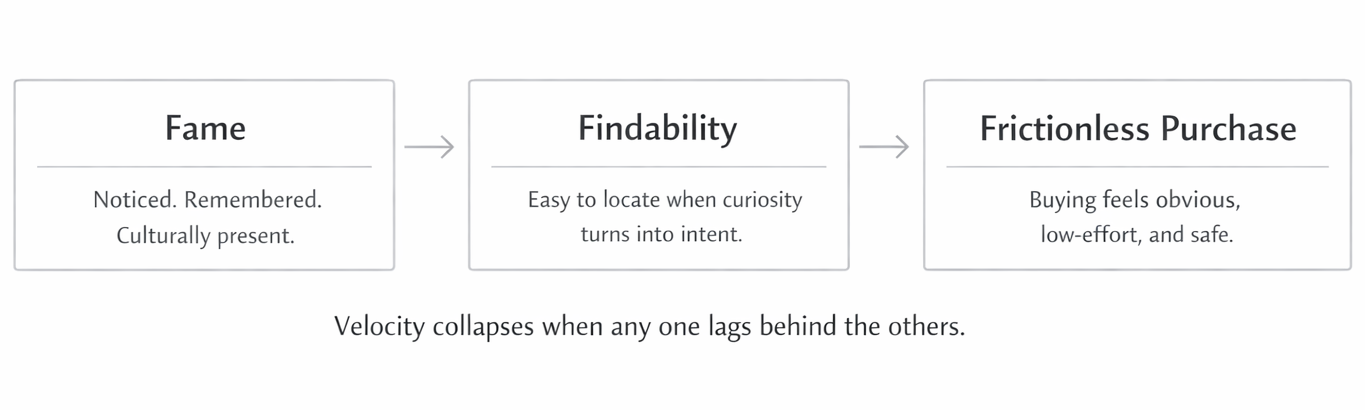
This imbalance is why brands can look “successful” on the surface while struggling to move volume underneath.
Why Brands Overinvest in the First and Underbuild the Other Two
The reasons are rarely strategic - they’re organizational. Fame lives in marketing. Findability lives in operations, sales, and retail. Frictionless purchase lives in systems no one fully owns. Marketing teams are incentivized to build attention. Sales teams are incentivized to push listings. No one is explicitly responsible for the connective tissue between them.
Add regulation, fragmented distribution, and delayed feedback loops, and the bias becomes inevitable: invest where results are immediate and visible. The cost of this imbalance doesn’t show up as failure. It shows up as plateau.
Brands don’t collapse - they stall. And stalling is harder to diagnose, harder to admit, and far more expensive over time.
What Changes When You Design for Velocity, Not Awareness
When brands shift their focus from creating attention to enabling movement, priorities change.
Media stops being evaluated only by reach and starts being judged by proximity to access. Creative is no longer asked to “break through,” but to reduce hesitation. Retail and digital touchpoints are treated as extensions of brand expression, not operational afterthoughts.
Most importantly, teams stop asking, “Did people see this?” They start asking, “Could someone act on this without effort?”
This reframing often leads to uncomfortable conclusions. Campaigns that look impressive may be doing very little work. Unsexy investments - distribution clarity, where-to-buy logic, retailer enablement - suddenly matter more than another wave of awareness.
Designing for velocity doesn’t make brands less ambitious. It makes ambition executable.
A Practical Diagnostic for Stalled Alcohol Brands
When an alcohol brand has awareness but weak velocity, the first step is not to increase spend. The first step is to locate the break. A simple diagnostic is to ask three questions.
1. Are we creating attention that points somewhere?
If a campaign creates awareness but does not guide the consumer toward a clear next action, the campaign is incomplete. The next action does not always need to be direct purchase. It may be finding a retailer, visiting a tasting room, asking for the product at a bar, joining a waitlist, trying a signature serve, or recognizing the bottle in-store. But there must be a next action.
2. Can consumers find the product when intent appears?
This is where many brands overestimate their own accessibility. A brand team may know where the product is sold. The consumer often does not. If availability is inconsistent, the brand needs to communicate access more clearly. If access is limited, the campaign should concentrate around markets or accounts where purchase is actually possible. Marketing demand into unavailable markets creates frustration, not growth.
3. Does the purchase moment reinforce the brand story?
The brand may look premium online but anonymous on shelf. It may feel culturally sharp in social content but unclear in retail. It may have a strong origin story but no simple serve, occasion, or reason to choose. This gap matters. The moment of purchase should not feel like a separate world from the campaign. It should feel like the campaign became real. That is the missing middle: the connection between what the brand makes people feel and what the market enables them to do.
The Question Every CMO Eventually Faces
At some point, every marketing leader encounters the same moment.
The brand feels alive.
The spend was justified.
The narrative holds.
But the numbers don’t move.
That’s when the real question appears - not in dashboards, but in conversations: Is this a visibility problem, or an access problem?
Answering it honestly requires more than metrics. It requires stepping back from tactics and seeing the system as a whole. CMOs who resolve this tension early build compounding growth. Those who don’t often spend years optimizing signals that never translate into velocity.
The difference isn’t effort. It’s where attention is applied.
A Final Thought on Growth That Actually Compounds
Sustainable alcohol brands are not built by amplifying awareness alone. They are built by aligning attention, access, and action into a single system that works quietly, repeatedly, and predictably.
When that system exists, growth compounds without theatrics. When it doesn’t, brands rely on spikes - and spikes fade.
The most effective marketing leaders are not those who generate the loudest moments, but those who remove the most friction between interest and purchase. That work is rarely visible. But it is where velocity lives.
Source and Method Note
This article is based on OhBEV’s experience analyzing alcohol brand growth systems, campaign performance patterns, retail and on-premise friction, and market-entry challenges. It is a strategic framework rather than a statistical market report.
.svg)


