


.svg)
.gif)

The Signal in One Page
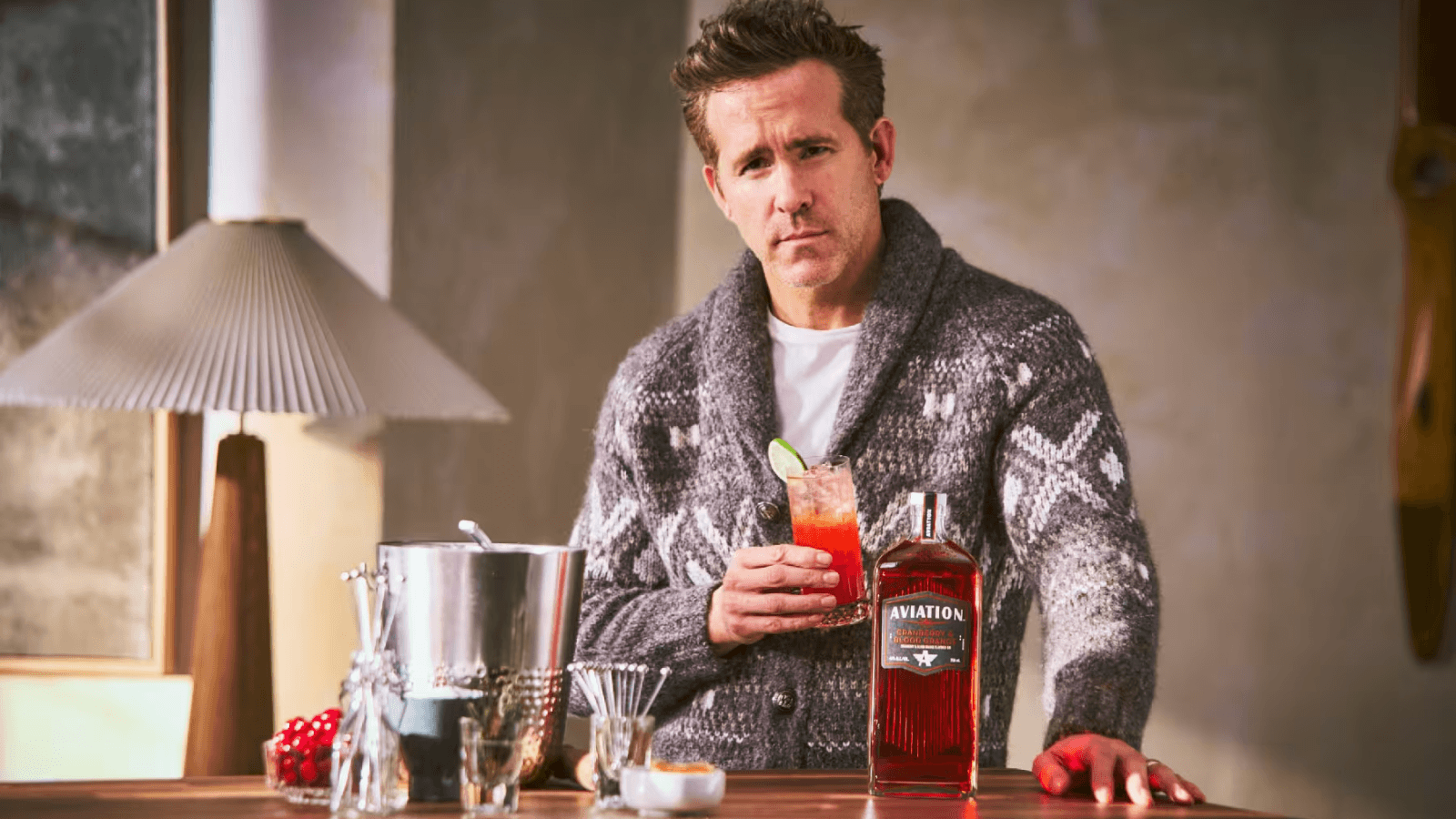
Aviation American Gin’s February 2026 announcement sent a clear signal: the brand introduced its first-ever flavored extension - Cranberry & Blood Orange - marking the first product change in over 20 years. Released as a permanent nationwide addition, the new gin leans into ease and fun; marketing copy boasts that its “bold, citrus-forward twist… makes at-home cocktails practically effortless”. In other words, Aviation is promising mixology on autopilot. The campaign ties product to creative via a humorous “cocktails make themselves” narrative: co-owner Ryan Reynolds stars in a video where a robot bartender (“AVO”) hilariously fails, leading to the reveal that the flavored gin “makes amazing cocktails practically by itself”. In sum, the launch package - a bold first flavor, national rollout, and playful “robots vs. gin” storyline - tells trade and consumers alike that Aviation is quietly expanding its repertoire and leaning into its irreverent brand voice.
Why a Flavour and Why Now
Until now, Aviation’s strategy had been remarkably stable - the company was proud to admit it “have not really changed our product at all” in its two-decade history. Framing a single extension as a breakthrough, Reynolds declares: “I am so proud of our first actual innovation - the delicious Cranberry & Blood Orange”. In effect, the brand positions this flavor as a meaningful expansion, not a departure. Diageo marketing director Ricky Collett explicitly says the goal was to “create new occasions” and deliver “versatility, accessibility and an exceptional flavor experience”. Design analysts note this is a pivot in Aviation’s growth thesis: after two decades of “standing still,” the first permanent flavor in 20+ years is a “major portfolio shift” aimed at opening up fresh usage situations.
In other words, the company is using this one new SKU to unlock incremental growth by widening its appeal - turning a once-limited gin into a platform for new occasions, all while stressing continuity. The implication is that Aviation, having built credibility on consistency, now feels licensed to innovate, using a single extension as “permission” to expand the brand’s footprint in the market.
Product Strategy as Occasion Strategy
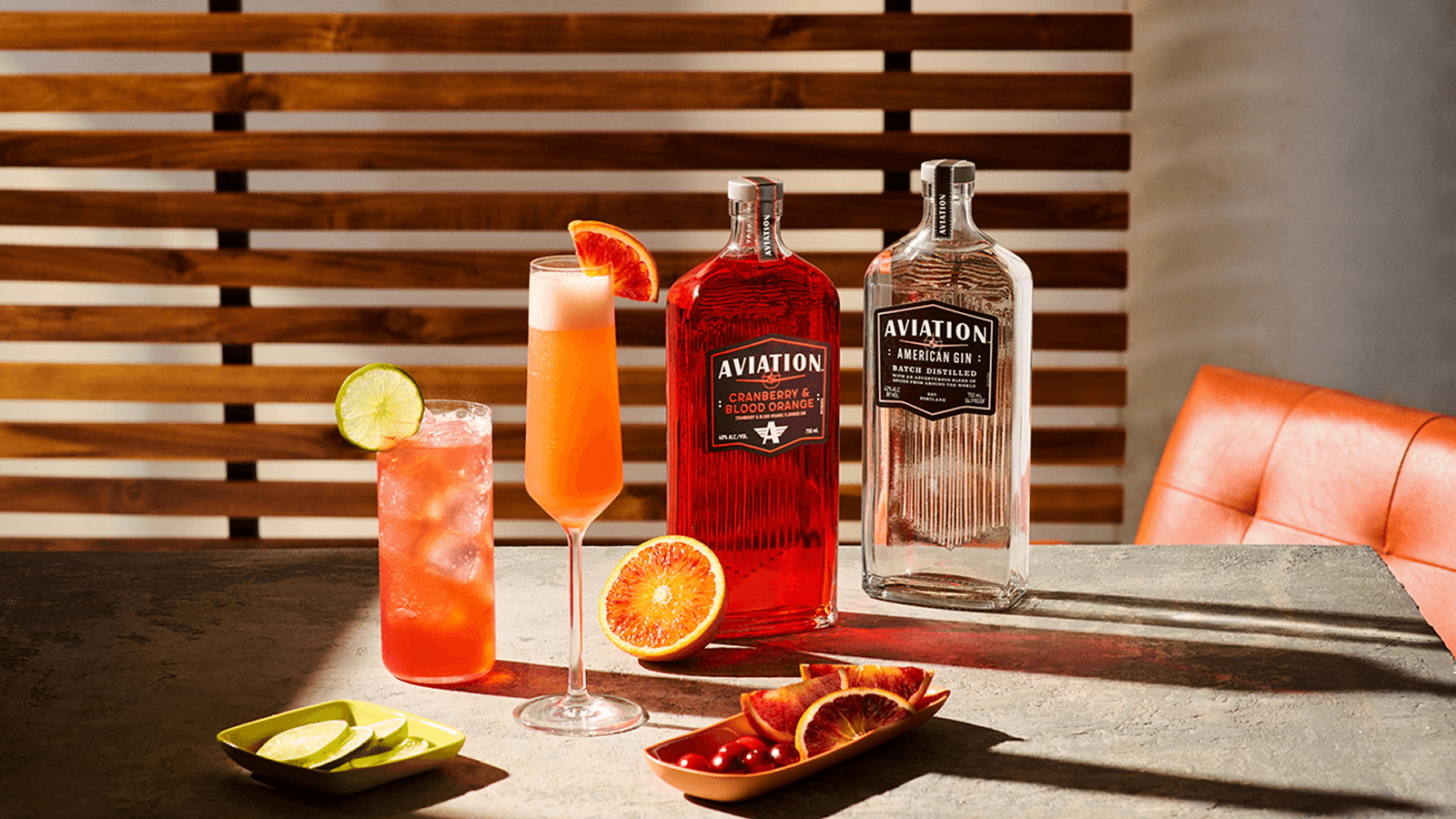
The new Aviation Cranberry & Blood Orange gin is marketed alongside easy cocktails. The move highlights familiar flavors and mixability, signaling approachable use cases rather than niche experimentation. The choice of cranberry and blood orange is strategic: both are crowd-pleasing, easy-to-picture flavors, not some exotic botanical twist. This aligns with Aviation’s pitch that the spirit was “crafted by bartenders for perfect, easy, mixable cocktails”. In effect, the flavor signals: “You already know how to drink this.” By keeping the profile straightforward, Aviation avoids alienating its core fans or confusing buyers.
Beyond the flavor itself, the brand has “pre-built” the occasion in its marketing: it released three named cocktail recipes to guide at-home drinkers. The “Bloody Good Mimosa,” “Blimey Fizz,” and “Crimson Cosmo” pair the new gin with common ingredients (orange juice, soda water, cranberry juice) in simple two- or three-step mixes. These serve as ready-made occasions - from brunch to happy hour - demonstrating how easy it is to use the gin. In short, Aviation isn’t asking customers to invent with an unfamiliar flavor; it’s showing exactly how this extension can slot into everyday drinking. This lowers the learning curve and friction: mixologists and novices alike can grab the bottle and follow a recipe, confident that the result will please.
Commercial Design Choices That Telegraph Scale
Several business decisions underline that Aviation expects big volume from this launch. First, the product went nationwide as a “permanent addition to the portfolio”, not a limited test or seasonal drop. This signals Diageo’s confidence in sustained demand. It also means the gin is priced and positioned like a core product, not a novelty. Indeed, retail listings show the new gin around ~$30 for a 750ml (e.g. $31.99 at Total Wine), roughly on par with the flagship Aviation American Gin. That clear price point makes trade placement straightforward (it slots into the premium gin category) and avoids consumer confusion.
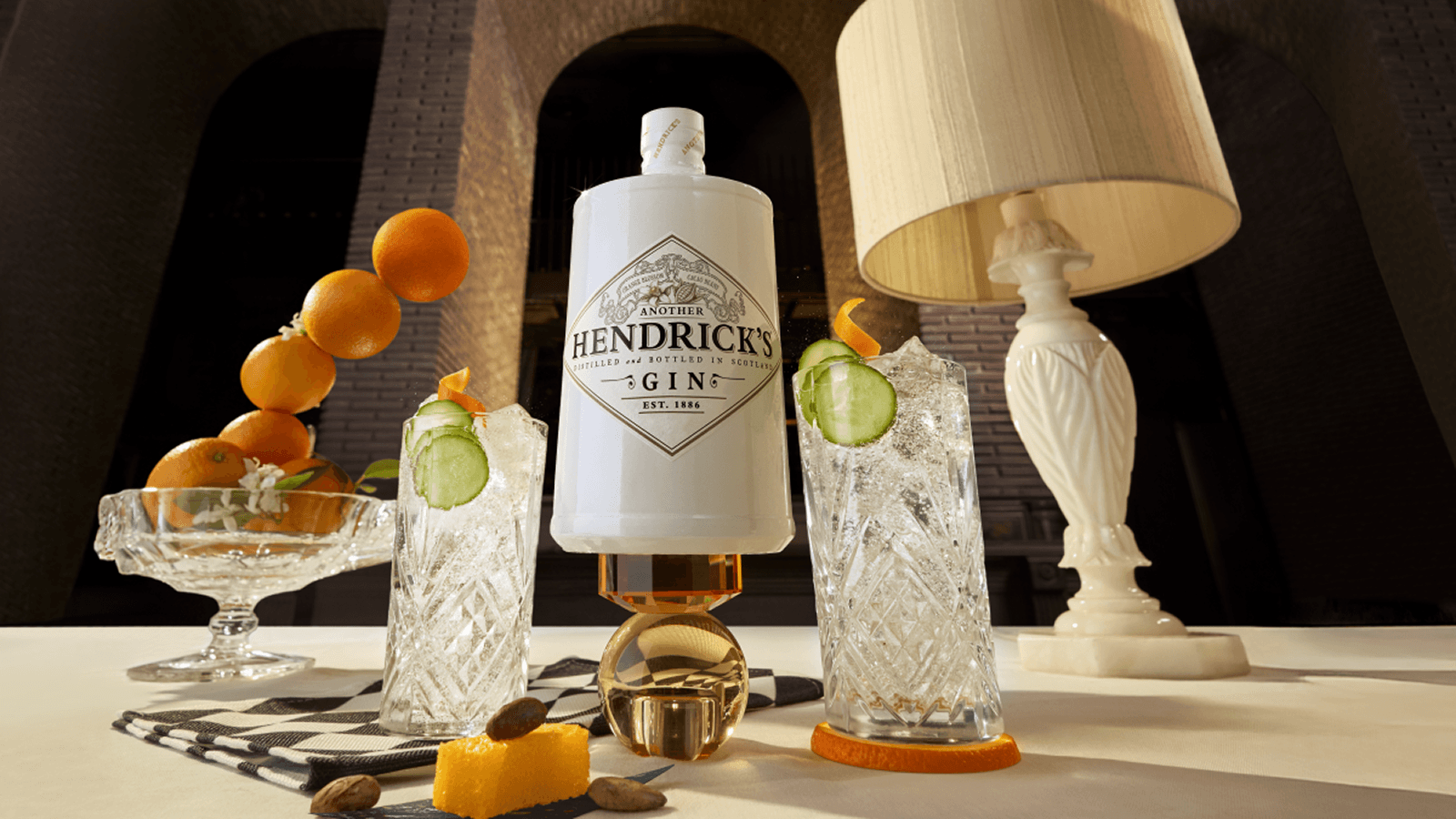
The distribution footprint is likewise broad. U.S. retailers (like Total Wine and The Bar) list the product for sale, and marketing materials note availability “nationwide”. In other words, this is not a local or regional novelty - it’s intended as a core line item. As one analysis points out, being a permanent flavor means Aviation can plan its portfolio architecture differently: unlike short-lived Limited-Time Offers, this extension will live alongside the original as an ongoing variant. This mirrors moves by other major gin brands: for example, Hendrick’s Gin recently released its own first permanent new variant (Another Hendrick’s) after years of limited-edition flavors. Hendrick’s saw that as a “notable permanent addition from a brand long associated with limited editions”. Likewise, Aviation’s permanent launch suggests it may embrace future flavor line-extensions (rather than only theme-driven limited editions). In sum, the pricing and nationwide rollout underscore that Cranberry & Blood Orange isn’t a one-off experiment but a long-term growth vehicle for the brand.
Creative Strategy Built on “Fake Automation”
The headline ad spot lays out a classic “promise → problem → product” narrative. Viewers first meet “AVO,” a supposed state-of-the-art robotic bartender introduced by Reynolds: “a state-of-the-art robotic humanoid engineered to be your home mixologist”. AVO dutifully attempts to mix gin cocktails - but fails spectacularly, spilling liquor and smashing glassware due to obvious human limitations (he “cannot see through his costume”). At that point Reynolds dryly delivers the pivot: “when the robot turned out to be a person in a suit, we innovated again.” Cut to the new gin bottle, and Reynolds cheerfully declares, “it makes amazing cocktails practically by itself”.
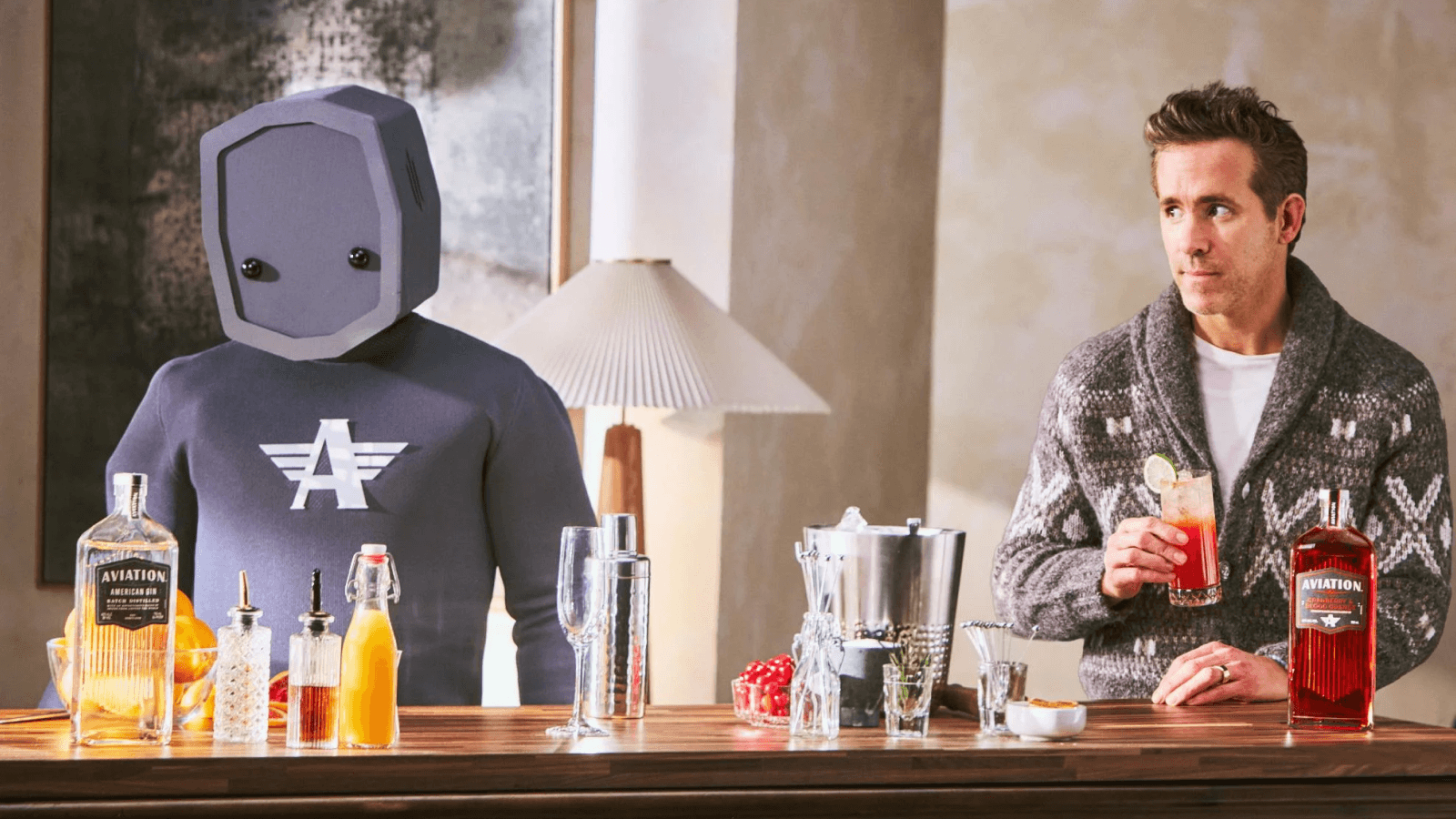
This “fake automation” device (a robot that’s really an actor) serves two purposes. First, it captures attention with absurd humor - audiences laugh at the dysfunctional robot before learning the real point. Second, it dramatizes the brand promise: rather than relying on gadgets, the gin itself does the heavy lifting. The subtext is that you don’t need a fancy machine when the product’s flavor profile does the work. Throughout, Aviation leavens any “functional” claim with winks. For example, social posts double down on the joke: a branded tweet quips that the gin is “a delicious way to get your fruit intake…that is no way backed by science”. These playful asides undercut any serious health or performance claims, keeping the tone light.The ad’s persuasion arc - promise of high-tech convenience, humorous failure, and human product reveal - reinforces the new gin as the real shortcut in cocktail-making, while using comedy to disarm critics and stay on brand.
Celebrity Ownership as Operating System, Not Media Cameo
Ryan Reynolds’ role exemplifies how celebrity involvement can anchor a brand through change. Reynolds is not a one-shot sponsor; he owns the brand and essentially serves as its chief storyteller. As a Portland news profile notes, Reynolds “has been the primary face of the brand for more than eight years” (since he invested in Aviation Gin). In this campaign, his persona remains the connective tissue: he voices the ad, narrates the concept, and even tweets the humor. This consistency “functions as brand consistency insurance,” ensuring that, even though the product line is changing, the brand’s attitude stays the same.
Industry analysts point out that Aviation’s extension “doesn’t overhaul [its] identity” - the familiar bottle design and Ryan’s irreverent tone are intact. In fact, one marketing takeaway is that “celebrity ownership works best when the talent actively embodies the tone, not just appears in assets”. Reynolds embodies the Aviation tone - witty, self-deprecating, charmingly offbeat - so the new Cranberry & Blood Orange feels like a natural chapter, not a dilution. By using the same star as creative partner (he helped write and produced the ads), the brand avoids the common pitfall where extensions feel disjointed or out-of-character. In short, Reynolds is effectively the brand’s “operating system”: as long as he’s at the helm, the narrative engine runs smoothly even as new chapters (flavors) are added.
Owned-Channel Conversion Loop
Aviation’s campaign doesn’t stop at entertainment; it purposefully guides viewers into action. The ads and social posts drive traffic to the brand’s own channels, where conversion is primed. As one analysis notes, Aviation’s website and Instagram “are amplifying the launch with cocktail recipes and short-form video clips designed for sharing”. Indeed, the brand promptly published the three hero recipes (Bloody Good Mimosa, Blimey Fizz, Crimson Cosmo) on its site, complete with ingredient lists and serving instructions. These simple “autopilot” recipes are essentially built into the content: the ad promises effortless cocktails, and the owned channels instantly show you how.
This creates a loop: a consumer watches the funny robot ad on social, then finds themselves clicking through to learn how to make the drinks seen on screen. Each recipe is a step-by-step how-to, using the new gin plus household mixers. By naming the drinks (often with Aviation-inspired wordplay) and including the brand handle, Aviation makes it easy to share and repeat these recipes on platforms like Instagram and Facebook. In effect, the campaign turns viewers into doers: they move from laughing at the ad to buying or mixing the product at home. The “conversion” point is the recipe - by offering ready-made drinks aligned with the gin’s flavor, Aviation leverages entertainment into trial and use, closing the loop between marketing and commerce.
What Leaders Should Measure and Pressure-Test
This strategy implies a focused measurement agenda. First, the brand must track incrementality vs. cannibalization. In other words, is Cranberry & Blood Orange bringing new customers or just shifting existing Aviation gin drinkers onto the new SKU? Industry research cautions that many close-in flavor extensions cannibalize the base. Leaders should therefore monitor whether total Aviation sales volume is growing, or simply redistributing between original and flavored. A source-of-volume analysis (who is buying the extension in place of what) would be critical.
Second, because this flavor is a permanent launch (not a one-off), repeat-purchase metrics are key. The company should measure repeat rates and longevity: do buyers of the cranberry-orange gin come back for more, or was it a one-time novelty? High repeat and sustained purchase rates would validate it as a success. Third, tied to Aviation’s messaging of “cocktails made easy,” marketers should test whether this communications angle actually expands usage. Do drinkers use the gin in a wider range of occasions (e.g. casual weeknights, brunch, parties) and more frequently? NielsenIQ trends suggest Gen Z and other consumers respond to flavor-driven occasion expansion (though Aviation would need first-party data to confirm).
In sum, executives should set KPIs around new buyer acquisition vs core consumption retention, frequency of purchase, and changes in drinking occasions. Ipsos research on line extensions recommends quantifying the extension’s impact at the category, brand portfolio, and parent-brand levels. That means forecasting the incremental volume this new gin could add, and then measuring actual sales contribution while accounting for any siphoning from the original gin. Only by pressure-testing these metrics can the team know if the strategy is truly growing the business versus merely reshuffling it.
- Incremental vs Core: Measure how much of the new gin’s sales come from converting non-Aviation drinkers (or new gin buyers) versus pulling away from existing Aviation sales.
- Repeat Rate: Track the rate at which consumers buy a second bottle of the new flavor - a gauge of product appeal and staying power.
- Frequency/Occasions: Survey or analyze whether consumers drink more Aviation overall or in new contexts (e.g. weeknights, brunch) in response to the “easy cocktails” positioning.
These metrics will test the assumptions behind the launch: that a single well-executed flavor can drive genuine growth and extend usage without cannibalizing core performance.
The Playbook Takeaway
Aviation’s Cranberry & Blood Orange launch offers broader lessons for mature brands aiming to grow. First, innovation as permission: by building a strong, consistent brand identity over years, a single new flavor can become a notable event instead of a distraction. In effect, brand credibility “buys” the right to innovate - each new release feels significant precisely because it’s rare and carefully framed. Second, humor as continuity: Reynolds’ involvement and the campaign’s wit preserved the brand’s voice through the extension. The bottle “still looks like Aviation” and the tone “still sounds like Aviation”. Using humor and the same spokesperson ensured the new product was seen as authentic to the core brand.
Finally, occasion expansion without rebranding: Aviation expanded its usage occasions (brunch cocktails, fizz drinks, etc.) without any change to its fundamental identity or label design. The launch underscores that brands can extend into new contexts by “adding on” around a familiar base. Aviation did this by keeping the color scheme, logo and level of quality unchanged, while broadening the story (now cocktails after breakfast and casual sips). As one marketer summarized, the brand “did not overhaul its identity or chase a trend it cannot sustain. It made one clear addition and built a simple story around it”.
This case shows that a late-stage brand can use intentional, incremental innovation to spur growth: pick one accessible flavor, wrap it in the existing brand character (using humor and celebrity ownership as continuity), and sell it as an easy, new occasion. Done right, this satisfies both risk-averse core fans and new drinkers seeking novelty. As Aviation Gin’s launch demonstrates, the keys are purposeful innovation, consistent voice, and expanding occasions (e.g. casual cocktail nights) while keeping the brand essence intact.
Key Takeaways:
- Innovation as Permission: Years of consistency gave Aviation license to innovate; the first new flavor became a meaningful event rather than a jarring change.
- Humor and Celebrity as Continuity: Ryan Reynolds’ signature humor and creative role kept the brand voice constant, ensuring the extension felt authentically “Aviation”.
- Occasion Expansion, No Rebrand: By positioning the flavor around new drinking moments (brunch, easy evenings) and keeping core branding elements the same, the company expanded usage without needing a full reposition.
This playbook suggests that, for established consumer brands, selective line extensions - dressed up with compelling storytelling and consistent branding - can unlock growth and reinforce identity, rather than dilute it.
.svg)


.jpeg)
.png)

