


.svg)

.gif)

As of May 2026, the coming FIFA World Cup 2026 is not just another sponsorship cycle for Stella Artois. The tournament will run from June 11 to July 19, span 104 matches, and create one of the longest, densest occasion calendars in global sport. Stella’s April 2026 campaign, fronted by David Beckham, is built around a blunt proposition: the real stadium for premium beer is not the broadcast, the concourse, or the social feed. It is the bar, where fans gather, order, compare, celebrate, and decide whether a premium pour is worth the extra money. That choice makes this campaign more commercially serious than a conventional event tie-in.

This review is based on official campaign announcements, tournament material, and recent channel research from market and drinks analysts. Taken together, those sources point to a clear conclusion. Stella did not use the World Cup merely to buy attention. It used the World Cup to make a very specific claim about where premium beer is won: in high-energy on-premise occasions where serve ritual, social proof, and first-trial behavior all converge. That is why the strengths of the campaign are real, but also why its lesson is narrower than enthusiasts may want to believe.
The Bar Is the Battleground, Not the Backup Plan
The campaign’s central move is not subtle. Stella says the bar is the “true home” of the World Cup experience, and that message would sound like empty poetry if the brand did not already have meaningful on-premise draft relevance. But the company anchored the claim with a trade fact: Stella is the number-three premium tap handle in the United States, according to Nielsen CGA data for the 52 weeks ending December 27, 2025. In other words, Stella is not approaching the bar as an aspirational fantasy. It is approaching the bar as existing infrastructure where it already has draft presence, visibility, and a plausible right to premium consideration.
That trade fact matters because the on-premise is still economically central. NIQ says bars and restaurants generate roughly half of total U.S. beverage alcohol dollars, and it also finds that visitation intentions remain positive in 2026, with around one in five consumers planning to visit more often than last year. Younger audiences are driving much of that momentum, which is especially relevant for a tournament that will create repeat group-viewing occasions over more than five weeks. Stella’s wager is therefore not that bars are culturally romantic. It is that bars still sit at the intersection of premium margin, social volume, and discovery behavior in a way most media channels do not.
What Stella understands better than many sponsorship marketers is that bars do three jobs at once. They are trial environments, because a consumer can order the product; theater environments, because glassware, draft presence, and crowd energy elevate the serve; and pricing environments, because a premium brand can justify a higher ticket when the moment feels communal and special. NIQ’s 2026 premium research reinforces this logic by showing that consumers increasingly define premium not only by exclusivity or ingredients, but also by how a drink is presented and served. That makes the bar more than a distribution point. It makes the venue part of the product.
There is also a practical advantage in Stella’s choice of battleground. NIQ notes that food-led venues are outperforming overall, but drink-led venues still over-index with younger consumers. A World Cup viewing program can therefore prioritize the subset of bars and bar-restaurant hybrids where premium beer is both visible and socially validated, instead of trying to force a premium story into channels that reward speed and price more than ritual. This is one of the campaign’s best judgments. It does not treat “on-premise” as one undifferentiated mass. It treats the right bar as a high-yield account.
The limitation is just as important. A brand without Stella’s draft base would have a much weaker case for making the bar its stadium. If a beer lacks handle distribution, training, or consistent premium execution, a bar-first World Cup strategy becomes wishful thinking: lots of association, little commercial capture. Stella’s move works because it begins from tap strength rather than hoping sponsorship will somehow create it. That distinction is the commercial spine of the whole campaign.
Turn Sponsorship Into Channel Strategy
Rights alone are never the real story in beverage alcohol. They are permission, not performance. FIFA’s sponsorship agreement with AB InBev extends the brewer’s relationship with the organization through the 2026 tournament, and the event itself will deliver rare scale: 48 teams, 104 matches, and a host footprint across Canada, Mexico, and the United States. But a logo in an official-sponsor package does not, by itself, convert viewers into premium drinkers. The hard part is translating abstract rights into a repeated purchase occasion across 39 days of match play. Stella’s campaign is notable because it starts from that problem, not from the easier vanity of rights ownership.
A tournament of this size behaves very differently from a one-night final or even a short playoff burst. Group-stage matches, knockout rounds, national-team watch parties, neighborhood rivalries, and weekend viewing rituals create waves of demand rather than one concentrated spike. Stella’s stated activation plan directly addresses that reality through curated viewing experiences in bars nationwide, alongside branded merchandise, limited-edition packs, and round-by-round sweepstakes. The important thing is not that those elements exist. It is that they are organized around where fans already gather for repeat occasions. The venue, not the rights badge, is doing the heaviest commercial work.
This is where Stella’s approach separates itself from a generic sponsorship model. A generic model assumes the sponsorship itself creates relevance. Stella’s model assumes relevance has to be re-earned in-channel, over and over, through sightlines, noise, social density, premium serve, and the immediate convenience of an order decision. That is a more operational view of sponsorship. It treats the World Cup as a demand calendar that has to be merchandised, not simply a media platform that has to be branded. The best part of the strategy is that it respects the difference.
That choice is especially smart in a pressured on-trade. IWSR says on-trade visits in most of the 15 markets it tracks were still declining year on year in late 2025, and those visits were becoming more “edited,” with people drinking fewer serves and fewer categories per occasion. Consumers were still willing to trade up selectively, but only when quality and occasion meaning justified the spend. In that market, sponsorship only matters if it helps the venue produce a better occasion. Stella’s campaign appears built around exactly that premise.
The broader strategic lesson is that premium brands should stop asking, “How can we leverage the rights?” and start asking, “Which channel behavior can the rights intensify?” In Stella’s case, the answer is obvious: bar gathering, ritualized serve, collective celebration, and first-trial capture. If a sponsorship cannot sharpen those mechanics in the channel that matters most, it is probably overpaying for prestige. Stella’s advantage is that it seems to know this from the start.
READ MORE: 2026 FIFA World Cup Alcohol Marketing Strategies
Premium Beer Wins Through Ritual
The most intelligent part of Stella’s creative is that it uses celebrity in service of behavior, not the other way around. The “Celebration” spot starring David Beckham draws a direct visual and emotional parallel between lifting the Stella chalice and releasing a goal celebration. That is a much stronger premium idea than simple fame borrowing. A celebrity cameo can buy notice for a few seconds. A ritual can create memory, repetition, and imitation at the exact moment the order is poured and consumed. Stella’s ad works because it understands that premium beer value is often built through how the product is held, served, and shared, not just through who endorses it.
That insight aligns almost perfectly with the latest premium research. NIQ says today’s drinkers do not all define premium the same way, but many use cues such as craftsmanship, ingredient quality, and the way a drink is presented and served. Stella already owns unusually strong ritual assets for a mainstream premium beer: the chalice, the branded glassware tradition, and its formal pouring ritual. In the World Cup campaign, those assets are not decorative heritage. They are working tools. The brand is effectively saying that the product is not just the liquid; it is the elevated act of drinking together.
There is also a useful evolution here from Stella’s earlier Beckham work. In 2024, the brand launched “A Taste Worth More,” positioning Stella’s taste and social cachet as more desirable than a brush with celebrity. In 2025, the Super Bowl follow-up expanded that platform into “For Moments Worth More.” The 2026 World Cup work sharpens the same strategic line but grounds it in a specific audience behavior: watching football together in bars. That progression matters. It shows a campaign moving from awareness-building humor toward occasion-specific retail and on-premise design. In review terms, this is a real improvement over a standard celebrity arc because the brand idea is becoming more usable in trade.
What sets Stella apart from many premiumization attempts is that its ritual is native to the product. The chalice is not bolted on for the World Cup. The pour ritual is not a one-off activation gimmick. The campaign simply found a sporting moment in which that existing ritual could echo something fans already do instinctively: raise arms, turn to friends, shout, clink, and replay the release of tension. That fit is why the idea feels stronger than a standard sports-sponsorship slogan. It is behaviorally congruent.
Still, ritual is only as good as execution. If Stella ends up served in generic pint glasses, plastic cups, or poorly managed draft conditions, the premium signal collapses fast. NIQ’s premium work repeatedly stresses that presentation is not a side note but a determinant of whether consumers perceive a drink as worth more. That is the hidden risk of the strategy. The ad may be elegant, but the brand must make sure the outlet experience deserves the promise. Premium ritual is persuasive only when the pour keeps up with the film.
One Portfolio, Distinct Jobs
The broader portfolio lesson is unusually clear. Anheuser-Busch says its World Cup roster is led by Michelob ULTRA, joined by Stella Artois and NÜTRL. The formal roles are distinct: Michelob ULTRA is positioned as the official beer sponsor, NÜTRL as the official hard seltzer sponsor, and Stella as a proud sponsor. That may sound like standard portfolio housekeeping, but it is actually one of the most important strategic facts in the whole setup. Rather than flooding the tournament with undifferentiated brand noise, the company is assigning specific jobs by audience, occasion, and channel.
Michelob ULTRA’s role is the broadest and most mass-reach friendly. The brand is carrying official-beer status into activations such as the Christian Pulisic U.S. Soccer jersey pack and wider soccer-facing activity across North America. In Canada, for example, Michelob ULTRA is attached to Canada Soccer House Halifax, a fan hub built to bring supporters together during the tournament. This is what a lead brand job looks like: broad soccer relevance, large-scale visibility, and an athletic, accessible positioning that can stretch across national-team fandom and mass retail.
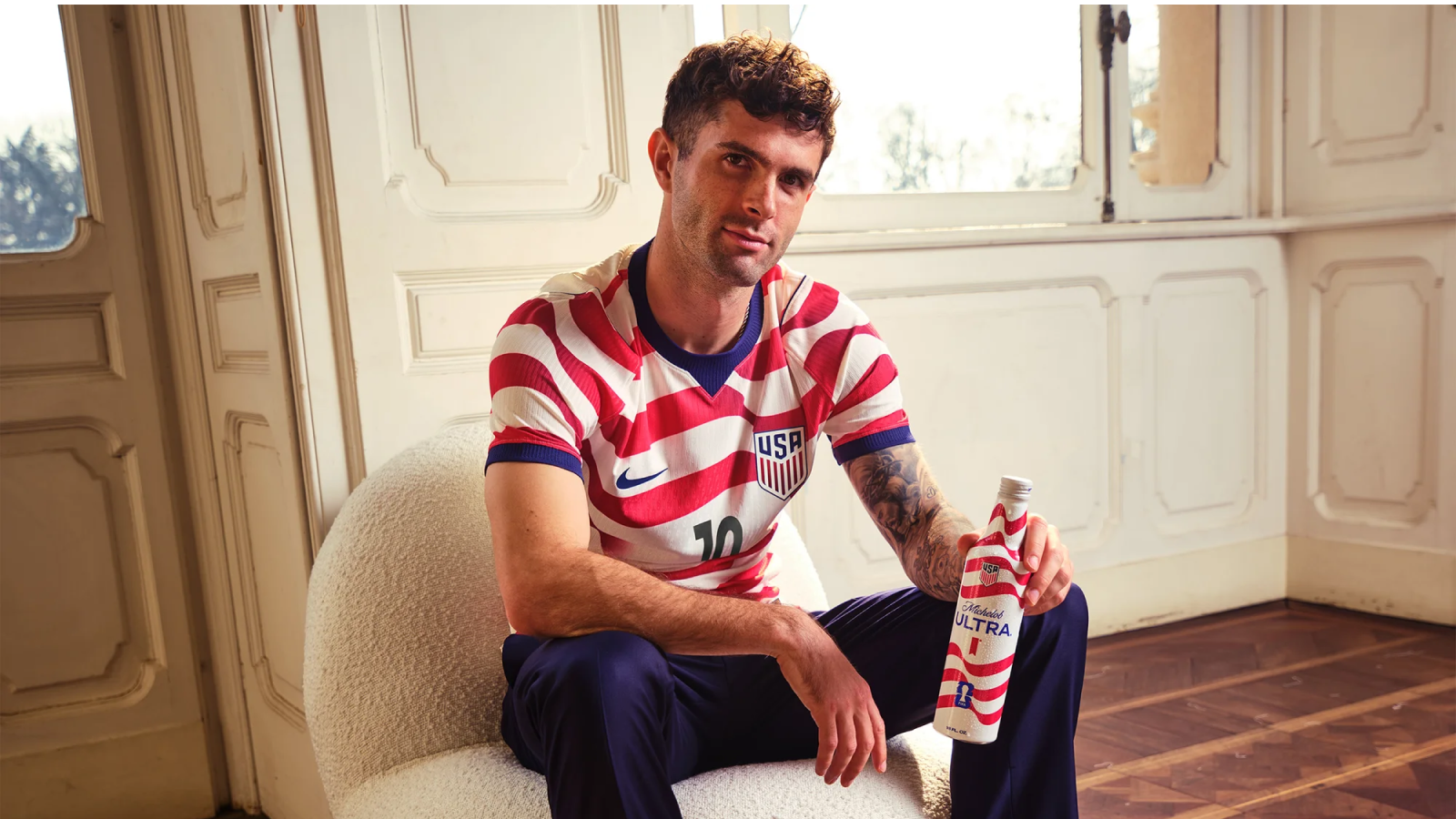
NÜTRL’s job is different again. As the official hard seltzer sponsor, it is explicitly playing across stadium, bar, and home occasions, with watch parties, drink specials, merchandise drops, daily digital sweepstakes, and a grand-prize path to the final. That is a smart use of the RTD format. NÜTRL can function in party-first settings, portability-minded occasions, and younger social spaces where “great vibes” and easy-drinking refreshment matter more than formal premium theater. It is an occasion-expansion role, not a ritual-elevation role.
Stella’s role, by contrast, is narrower and more valuable for exactly that reason. It is not being asked to own all soccer. It is being asked to own the premium on-premise version of soccer. Its activation centers on curated bar experiences, merchandise, limited-edition packaging, and the chalice-led “Celebration” narrative. If Michelob ULTRA is the roster captain and NÜTRL is the mood-setter across flexible formats, Stella is the brand that turns a match watch into a premium social ritual. That clarity is strategically superior to the common mega-event mistake of letting every portfolio brand chase the same fan in the same way.
This is where the campaign becomes genuinely instructive for beverage leaders. The best portfolio architecture does not ask every brand to exploit every moment. It asks which brand is best suited to which job. If the goal is national-team pride at high scale, Michelob ULTRA is a more natural fit. If the goal is easy-entry RTD participation across mixed settings, NÜTRL makes more sense. If the goal is to justify a premium draught order in a crowded bar where atmosphere is part of what is being purchased, Stella is the right instrument. This comparative fit is what makes the company’s setup stronger than a simple “more brands equals more wins” approach.
The weakness, if one appears, will come from overlap. If Michelob ULTRA, Stella, and NÜTRL all show up with similar creative, similar venue logic, and similar trade asks, the elegance of the architecture will disappear. But on the evidence available so far, the roles are more disciplined than that. For leaders reviewing the campaign, that discipline may be the most portable insight of all.
Value and Vibe Must Coexist
The laziest reading of Stella’s campaign would be to call it another example of premiumization and move on. That would miss the market. NIQ’s read on the U.S. on-premise in 2026 is that consumers want “value and quality in the same glass,” and its broader beverage alcohol analysis argues that the future is about balancing value and vibe rather than choosing one over the other. That is not premiumization as swagger. It is premiumization under scrutiny. Consumers are still willing to spend, but they want visible reasons. That is why Stella’s campaign is stronger as an earned trade-up play than as a status play.
IWSR is even more blunt about the pressure. Its April 2026 analysis says alcohol spend continued to decline across most major markets in 2025, the long-running premiumization trend slowed and in some cases slipped into reverse, and total beverage alcohol volume across leading markets fell 2% while value fell 4%. Its work on the on-trade adds that people are editing their visits, drinking less, earlier, and more selectively, while still pursuing quality over quantity when they do go out. For premium beer marketers, the message is clear: the trade-up is not dead, but it is no longer automatic.
Premium beer itself sits in a particularly nuanced position. IWSR reported in late 2025 that global premium-beer growth had gone into reverse in the first half of the year, pressured by uncertainty and shrinking consumer expenditure. In the United States, premium beer was hit by RTD competition and by roughly 20% price inflation over the prior four to five years. Yet the same analysis also found that premium-and-above beer still posted volume gains in 12 of the world’s top 20 markets, showing that the segment is pressured, not invalidated. That is exactly the environment Stella is entering: a market where premium beer can win, but only if it feels worth it.
This is where Stella’s bar strategy becomes more compelling than a shelf-only premium push. NIQ’s premium research says consumers often connect premium with craftsmanship, ingredients, and presentation, and it also notes that, given a fixed budget, many would rather buy one or two higher-quality drinks than four or five cheaper ones. In other words, premium is not simply a higher price point. It is a more defensible experience bundle. A loud, emotional World Cup bar occasion gives Stella a better chance to assemble that bundle than a cold retail shelf ever could.
That does not mean Stella is the right answer for every occasion. For price-led group gatherings, convenience-led home viewing, or consumers primarily optimizing for affordability and functional refreshment, the portfolio’s other brands may be better aligned. But for the set of occasions where fans want a little ceremony, a little social theater, and an excuse to upgrade the first round, Stella’s proposition is well-tuned to the times. The key is that it has to earn the trade-up every pour. It cannot assume heritage or event association will do the job on their own.
Packaging, Merch and Social Should Extend the Pour
A weaker campaign would have treated limited-edition packs, merchandise, and sweepstakes as cosmetic add-ons. Stella’s official materials suggest a more integrated reading. The bar experiences are the core, but the brand is explicitly extending the program through limited-edition packaging, co-branded merchandise, and the “All Rounds on Beckham” sweepstakes, which runs across every round of the tournament. The official Stella site is also foregrounding tournament merchandise and even the personalization of chalices. Those are not trivial extras. They are clues that the brand understands the difference between a moment and a memory system.
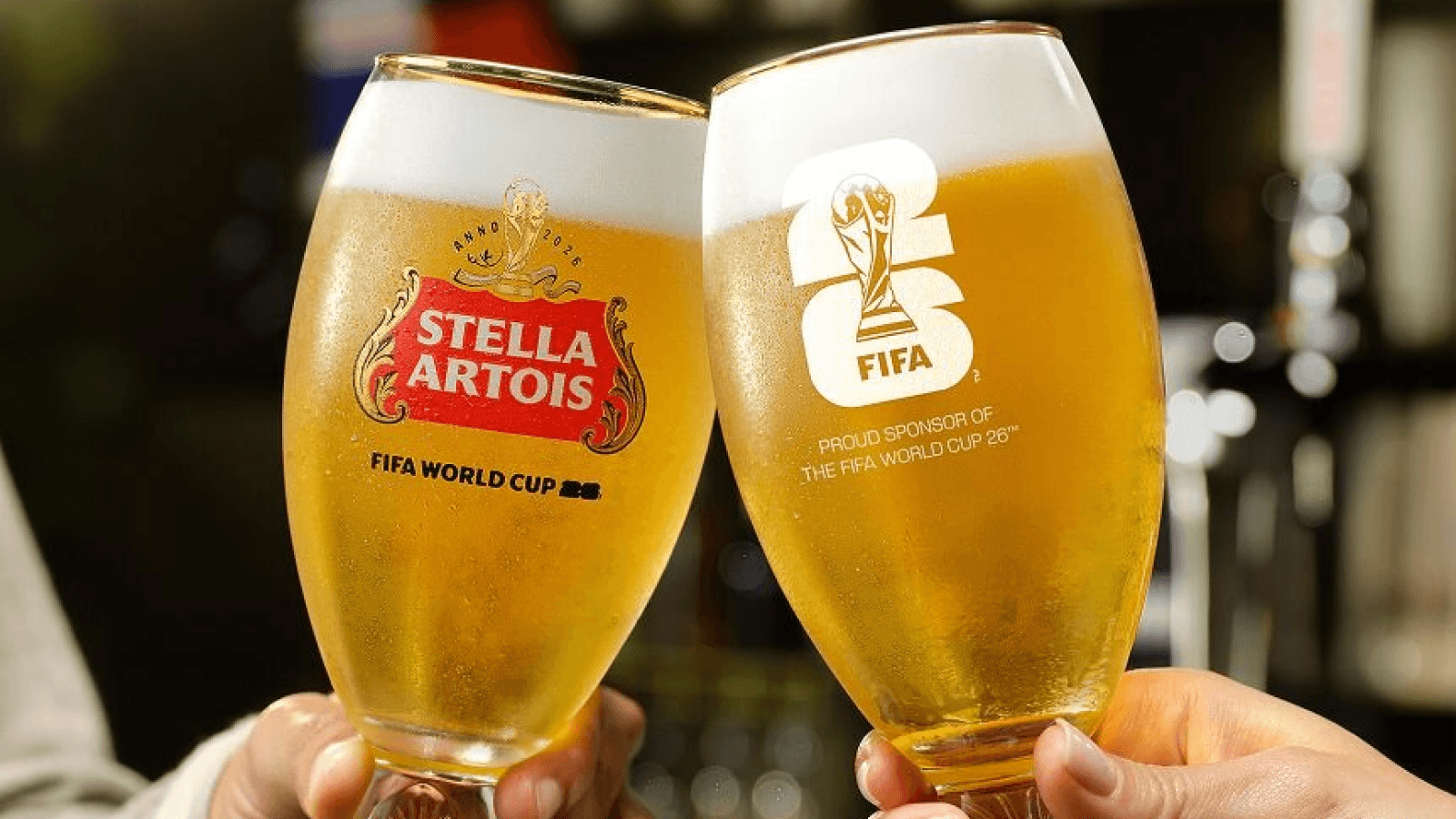
The commercial logic is straightforward. Packaging carries the bar cue into the store and the fridge. Merchandise carries the cue into repeat visibility, gifting, and social signaling. Sweepstakes create a recurring reason to return to the brand during a long tournament calendar instead of only at launch. When these pieces are tied to the same core asset system, they do more than broaden reach. They lengthen the life of the premium occasion, allowing a bar-first campaign to echo across home viewing, pre-game purchasing, and post-match conversation. That is why “extension” is a better word than “amplification.” The pour is the origin point. The other assets should keep leading back to it.
The portfolio comparison is useful again here. Michelob ULTRA’s jersey-pack activity works because it extends national-team identity into packaged retail. NÜTRL’s digital spin-wheel and final-prize mechanic work because they extend its party-oriented, flexible-occasion role into daily participation. Stella’s extensions are different. Their job is not just to create tournament buzz; it is to preserve a premium bar code outside the bar, especially through chalice symbolism, collectible cues, and round-based engagement tied back to shared viewing. Each brand is extending its own core job, not borrowing someone else’s.
This matters because too many alcohol campaigns mistake object abundance for strategic depth. Merch does not matter because merch exists. Packaging does not matter because cans got a redesign. Social promotions do not matter because they can produce impressions. They matter only if they help consumers re-enter the brand’s intended occasion. For Stella, that means making the consumer more likely to remember the premium serve, choose the brand again in a future viewing occasion, or recognize it faster at retail because the bar experience gave the pack emotional residue. That is a high standard. But it is the correct one.
If the extensions drift too far from the bar-centered idea, they will feel like garnish. If they remain tightly connected to the chalice, the viewing ritual, and the repeated rhythm of tournament rounds, they can do something more valuable: turn a sponsorship campaign into a multi-touch behavior loop. Stella’s materials suggest the brand understands that distinction, and that is why these peripheral-looking assets deserve to be treated seriously in any strategic review.
Measure the Halo, Not Just the Pour
The most underrated part of the campaign is measurement. Many drinks marketers still evaluate on-premise activations too narrowly, as if the only question were how much draft volume moved during match windows. NIQ’s U.S. beverage alcohol research shows why that is incomplete. In neighborhood bars, winning the first drink of the night is critical because 80% of consumers then stick with the same category and brand. NIQ also finds that 73% of Gen Z and regional-craft drinkers are more likely to buy a brand in-store after trying it in a bar or restaurant, and 69% say they already have done so. Those numbers should completely change how a World Cup bar program is judged.
The first implication is that “first-order capture” matters more than many brand teams admit. If Stella wins the opening round in a high-energy match-viewing occasion, it has a materially better chance of winning the second, third, and fourth orders in that same visit. The second implication is that the value of the night does not end when the tab closes. Off-premise purchase behavior is planned, and NIQ says 78% of off-premise BevAl purchases are planned and linked to same-day consumption. That means a bar program can seed later retail missions if the trial experience is strong enough to survive the trip to shelf.
That is why the right KPI set is broader than short-term pour volume. It should include whether the brand wins the first order, whether draft velocity improves in the right accounts during tournament windows, whether those accounts are the sort of venues that actually reinforce premium perception, and whether surrounding retail markets show lift after on-premise trial. Those last two measures are especially important. A premium brand can pour a lot of volume in the wrong bars and still weaken its image, or it can post flatter nightly volume in better venues and build stronger downstream pull. The correct framework is not “how much liquid moved?” but “what kind of trial did the brand create, and what did that trial do afterward?” That is an inference from NIQ’s data, but a strong one.
In practice, sophisticated teams should be looking for matched-market or account-cluster evidence of halo, not merely event-night depletion. If Stella invests in curated viewing experiences, the measurement model should test whether those venues generated better first-order capture, stronger brand stickiness during the session, and improved retail performance in nearby stores or among exposed shopper groups. A World Cup program that only reports bar volume is telling leadership the least interesting part of the story.
This is also where Stella’s strategy has an advantage over broad awareness sponsorships. Because the occasion is happening in a purchasable environment, the brand can tie visibility much more closely to behavior. That makes the campaign more accountable than a pure media buy. Done properly, it should let Stella learn not just whether people saw the message, but whether the bar experience changed what they ordered now and what they bought later. In a cautious market, that is the kind of accountability premium brands need.
Read the Signal Correctly
The right conclusion from this campaign is not that all on-premise investment is now smart. It is that a brand with the right preconditions can use a mega-event to sharpen channel relevance. Stella has several of those preconditions at once: meaningful U.S. tap strength, a premium ritual system built around the chalice and pouring ceremony, a tournament with 104 matches running from June 11 to July 19, and a portfolio structure in which the lead beer, premium lager, and hard-seltzer roles are clearly divided rather than chaotically overlapped. Those conditions are unusually favorable. They make the strategy impressive, but they also make it less universally transferable than celebratory case-study writing often implies.
IWSR’s market backdrop is the critical reason to keep that nuance intact. Premiumization has slowed, consumers are spending more deliberately, and on-trade visits remain pressured and increasingly edited. In that environment, copying Stella without Stella’s assets would be dangerous. A brand with weak draft distribution, limited premium serve codes, shaky outlet execution, or a consumer base more motivated by value than theater could spend heavily on bar activations and still fail to generate either immediate trade-up or downstream retail pull. The narrowness of Stella’s lesson is not a weakness in the campaign. It is part of why the lesson is useful.
The campaign also should not be read as proof that premium always wins during mega-moments. It is better understood as proof that premium can still win when it shows up in the right place, with the right cues, for the right occasion density, and with credible in-channel execution. NIQ’s premium work makes clear that consumers increasingly decide what is “worth it” based on the total experience of the drink, not simply on a premium label or higher price. Stella’s World Cup plan appears to accept that discipline. It is not asking consumers to admire premium from afar. It is asking them to feel premium in the hand, in the glass, in the crowd, and then decide that it merits the extra spend.
That is why the campaign deserves a strong review, but not a naive one. Its great strength is precision. Stella did not chase the broadest possible soccer message. It built a premium-on-premise message that suits its assets and market position. Its potential downside is equally clear: if the bars chosen are wrong, the execution is inconsistent, or the premium cues do not survive real trade conditions, the theory gets exposed quickly. But strategy should be judged by whether it aligns brand truth, channel economics, and consumer behavior. On those terms, Stella’s World Cup work is sharper than most alcohol sponsorships of this scale.
The most useful final reading, then, is this: Stella is not proving that sponsorship spending is enough, or that premiumization is effortless, or that bars are automatically the future for every beer brand. It is proving something narrower and more practical. A beer with real handle presence and a credible ritual can use a long-runway mega-event to turn bars into conversion engines, justify a premium price in a skeptical market, and create retail pull that outlasts the final whistle. That is not the broadest lesson available from the campaign. It is the best one.
Editorial Note: This article was developed by OhBEV as an alcohol marketing analysis based on publicly available campaign information, industry reporting, and OhBEV’s experience in brand positioning, campaign strategy, and alcohol marketing execution.
.svg)


.png)
%20(1).png)

