.svg)
.png)
.gif)

Executive Summary
China’s baijiu industry is by far the dominant spirits market globally. In 2024 baijiu sales in China reached roughly $111 billion, accounting for over 70% of China’s total alcohol market value. Major research firms project continued growth: Verified Market Research (VMR) estimates global baijiu rising from about $82.4B (2024) to $124.5B by 2032 (CAGR ~5.3%), while Grand View forecasts the global market climbing from $157.8B (2024) to $225.4B by 2033 (CAGR ~4.0%). Baijiu is even “the world’s most consumed spirit by volume,” with 2025 revenue above $115B. Growth is fuelled by China’s rising incomes, deep cultural demand, and a boom in premium/luxury segments. At the same time, younger consumers are shifting toward lighter and novel beverages, and international expansion is opening new niches. Key takeaways for baijiu producers and brand owners include:
- Premiumization: A growing middle/upper class is trading up to premium and ultra-premium baijiu as a status symbol. Leading firms like Kweichow Moutai and Wuliangye enjoy lion’s share of value. Brands should reinforce high-end positioning (e.g. aged expressions, collectible editions) and luxury branding to capture this trend.
- Digital & E‑commerce: Online liquor sales are surging. Platforms like Tmall and JD.com now account for a large and growing portion of baijiu retail. Live‑streaming sales events, social commerce and influencer campaigns (e.g. KOL endorsements) are especially effective with younger audiences. Baijiu marketers must aggressively embrace e‑commerce and digital marketing to reach millennials/Gen Z.
- Global Expansion: Although exports are still small (~0.2% of production), opportunities exist. Chinese diaspora communities in Hong Kong, Macau, Singapore, the US and Japan already drive most overseas demand. Global cocktail culture and specialty spirits bars also create openings. Strategic initiatives include targeted export to Chinese expatriate and “Asian-fusion” markets, brand collaborations (e.g. sports sponsorships like Wuliangye’s FIFA World Cup launch), and education campaigns (mixologist promotions, tasting events). High-level forecasts (chart below) show continued growth for both China and global markets, with possible best‑ and worst‑case bands under different scenarios.
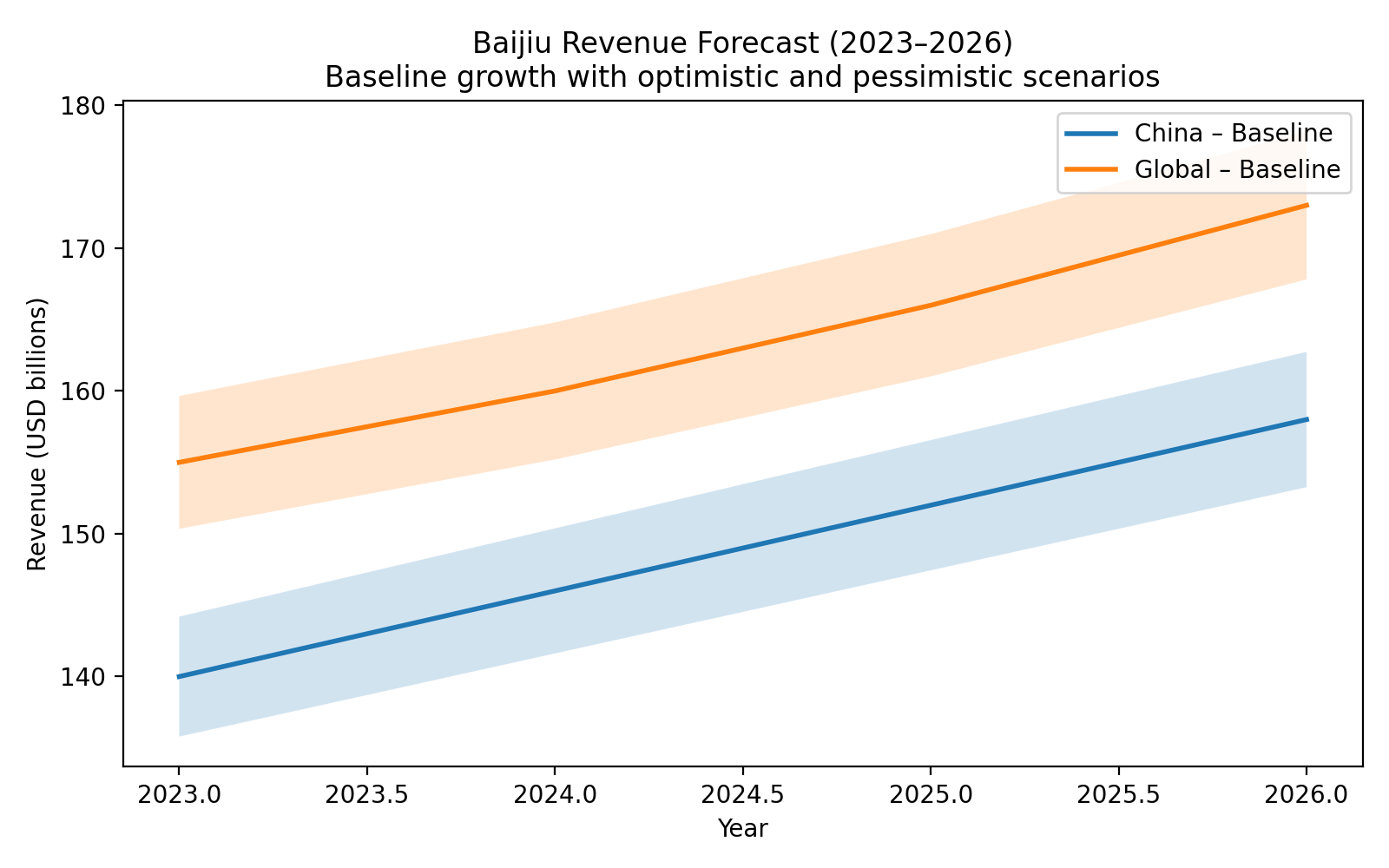
Figure: Global vs. China Baijiu Revenue Forecast (2023-2026). Based on industry projections, China’s baijiu market (red line) is expected to grow at ~4% annual CAGR while the global market (orange line) expands 4-5%. Shaded bands illustrate optimistic and pessimistic scenarios under accelerated global demand or regulatory slowdowns.
Global Market Context & Macroeconomic Outlook
Baijiu’s macro environment is shaped by overall spirits demand and Chinese economic trends. Globally, the alcoholic beverages market is expanding (spirits CAGR ~3-5% through 2030). Within that, baijiu is a special case: China dominates consumption, but analysts project healthy growth. As noted, VMR pegs global baijiu at $82.4B (2024) rising to $124.5B by 2032 (CAGR ~5.3%), and Grand View puts it at $157.8B (2024) to $225.4B (2033, CAGR 4.0%). The discrepancy reflects scope differences, but both agree on high single‑digit growth. The APAC region leads the market: Grand View reports Asia-Pacific at 53.2% of global revenue in 2024, and China alone accounts for roughly 90%+ of world baijiu consumption. In China, baijiu’s share of the entire alcohol market is over 70% by value.
Economically, rising Chinese incomes are a key driver. The expanding middle class has more disposable income for luxury goods and premium spirits. Retail sales of alcohol in China grew strongly in recent decades, supporting baijiu demand. Culturally, baijiu remains deeply embedded: it is traditional toasting liquor at business banquets, weddings and festivals. This ritual use provides a durable demand base. On the other hand, China’s demographic shift - younger adults with global tastes - means domestic growth may moderate. Nevertheless, China’s baijiu market (anchored by its size and culture) is still expected to expand, driven by premiumization and consumer upgrades.
Eurasian and global economic factors also matter. As China’s GDP grows, consumer spending on alcohol generally rises. Risks include slower overall growth or policy tightening, but such macro forces are only one part of the story. The chart below illustrates the long-term baijiu market growth forecast (projecting to 2030) and the regional split (China vs. Rest of World). Even under conservative assumptions, both China and global markets are expected to keep rising through 2026-2028.
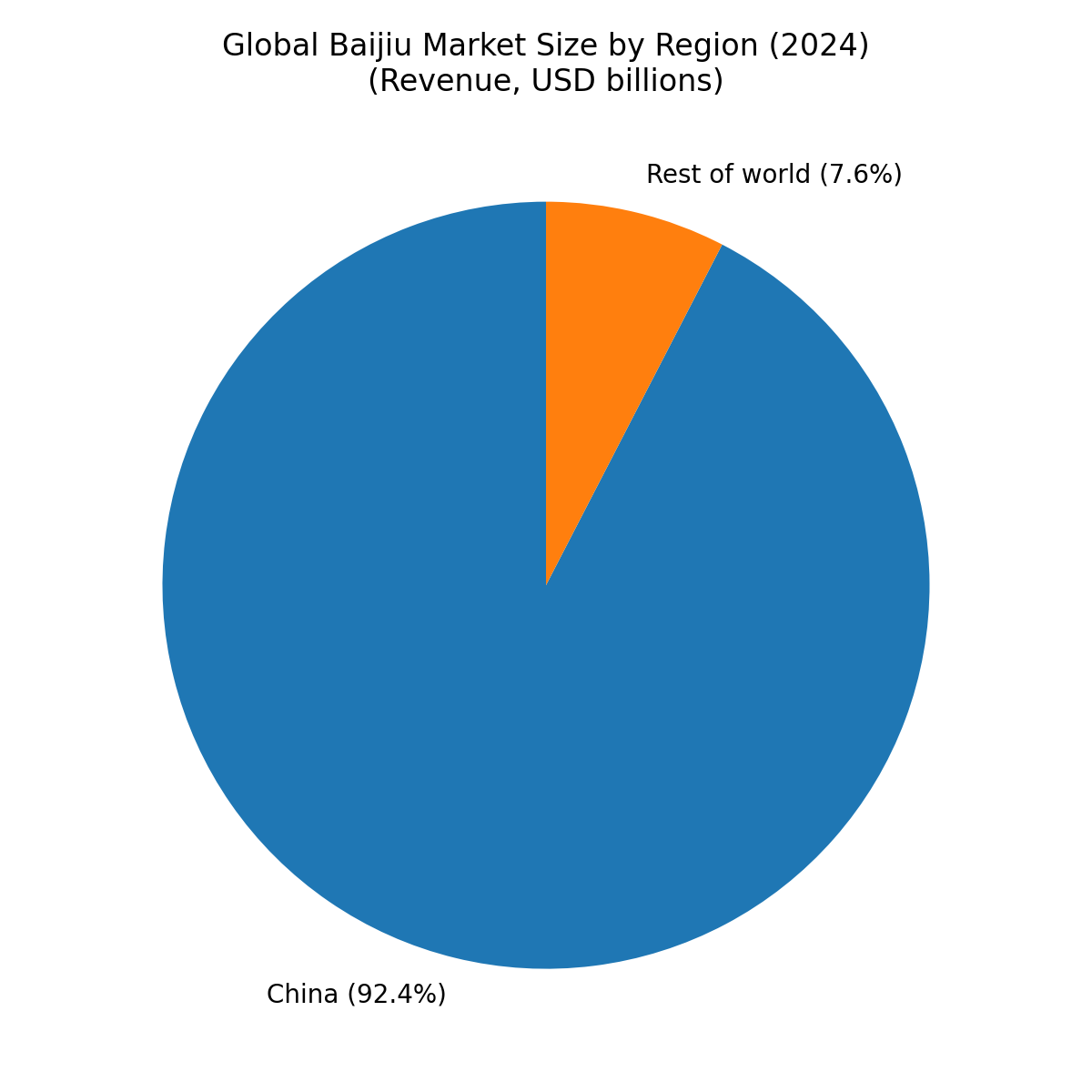
Figure: Global Baijiu Market Size by Region (2024). China dominates the baijiu market, comprising roughly 90% or more of revenue. In 2024 China’s baijiu sector was on the order of $146B, compared with ~$12B in the rest of the world. This pie chart highlights the China vs. rest-of-world split based on market estimates.
China Domestic Market Analysis
China’s baijiu market is the world’s largest and most complex. Recent official data (e.g. Grand View) put China’s baijiu market at ~$145.7B in 2024, with forecasts to $204.2B by 2033 (CAGR ~3.8%). (Other sources vary: Intel estimates about $92.4B in 2024 and growth at 3.4% to 2032.) The market is stratified by flavor (aroma) type and by price segment. The traditional aroma categories are Strong-aroma, Sauce-aroma (Maotai style), Light-aroma, and Rice-aroma, each appealing to different regional tastes and consumption occasions. For example, Sichuan provinces favor Strong-aroma (Luzhou, Wuliangye), Guizhou and Zhejiang favor Sauce-aroma (Moutai, Langjiu), etc. By price, offerings range from low-cost economy baijiu up through super-premium gift bottles. The economy/entry segment still accounts for the plurality of volume: Grand View notes “economy baijiu” held ~45.1% of China’s baijiu market by revenue in 2024. Ultra-premium (collectible aged spirits) is the fastest-growing category (projected +4.3% CAGR), reflecting the status appeal of luxury liquor.
The market is highly concentrated. A handful of state-owned giants dominate value share. Kweichow Moutai (supplier of official Banquet Moutai) is the clear leader, followed by Wuliangye (from Sichuan) as #2. These two alone account for a huge portion of premium sales - brand valuations over $50B and $26B respectively. Other major players include Luzhou Laojiao, Yanghe, Fenjiu, and even craft/artisanal producers. As one recent report notes, “the industry is highly concentrated with a few giant players like Kweichow Moutai and Wuliangye controlling the majority of market value”. Indeed, the pecking order has been clear: Moutai at the top, Wuliangye firmly #2, and the #3 spot rotating among Luzhou Laojiao, Fenjiu or others.
Segmentation by Price
In China, baijiu brands are often grouped by price tiers: mass-market (everyday) versus mid- and high-end gift brands. Moutai and other super-premiums now retail for thousands of yuan per bottle, vs. economy baijius under a few hundred. This tiering influences distribution and marketing. According to Grand View, “Ultra-premium baijiu is anticipated to witness a CAGR of 4.3%”, outpacing economy categories. Growth in mid- and high-premium segments is particularly strong as affluent consumers seek prestige and collectors’ items.
Drivers (China-specific)
The Chinese baijiu market still revolves around gift-giving and banquets. Baijiu is the traditional liquor for toasting at business dinners, weddings, Lunar New Year gatherings and government receptions. This has built in robust demand: formal occasions often mandate baijiu consumption, giving manufacturers a resilient base. Premiumization is another driver: as incomes rise, more consumers “trade up” from cheap baijiu to premium brands as status symbols. For example, it’s common to see high-end baijiu bottled gift sets given at holidays or offered as corporate gifts.
Headwinds (China-specific)
However, two major trends pose challenges. First, China’s anti-extravagance campaign - government austerity and curbs on official spending - has reduced demand for luxury baijiu in state banquets. Premium labels like Moutai saw slower sales as officials cut back on banqueting expenses. Second, China’s young consumers are increasingly health- and trend-conscious. Many millennials and Gen‑Z find traditional baijiu “too strong” or old-fashioned. They prefer lighter, lower-ABV options (such as wine, beer, cocktails or new low-alcohol baijiu variants). Producers are responding by introducing fruit-infused, chillable, and lower-proof baijiu for home or bar consumption (e.g. Jiangxiaobai’s flavored lines). Finally, baijiu consumption is geographically uneven: Tier 1 cities and wealthier provinces account for much higher per-capita intake than rural areas, though rural penetration is gradually expanding through price tier segmentation.
Overall, China’s domestic market shows continued growth in value terms - fueled by premiumization - but also evolving preferences. The chart below (not shown) would illustrate market share by brand/segment, and the shift in demographics.
International Market & Export Opportunities
Outside China, baijiu remains a niche but emerging category. In recent years Chinese manufacturers have pushed exports and foreign presence. However, baijiu exports are still a small fraction of output: in 2023 exports were only about 15 million liters (≈0.2% of production). In 2025 export value reached only $704 million (first nine months). The top international markets are places with Chinese communities or open tastes: Hong Kong, Macau, Singapore, the United States, and Japan. (Hong Kong alone handled ≈40.6% of all baijiu exports in 2025.) Notably, Hong Kong in late 2024 slashed its imported liquor tax (from 100% to 10% on high-end spirits) to boost duty-free trading - a major win for baijiu exporters.
The Chinese diaspora plays a key role. In many Chinese restaurants, grocery stores, and cultural events abroad, baijiu is in demand as a taste of home. Grand View reports that rising Asian diaspora populations, along with global enthusiasm for Asian food/drinks, are “helping to normalize baijiu consumption” in countries like the US. The US mixologists increasingly experiment with baijiu cocktails as a unique, exotic ingredient, introducing it to curious consumers. Brands like Ming River (Dark Horse) are marketing baijiu in the U.S. as a premium cocktail base.
Global cocktail culture and on-trade distribution are slowly lifting awareness. Baijiu is being placed in international duty-free shops, high-end hotel bars, and spirit festivals. For example, some Chinese distillers have partnered with global distributors and hotel chains to feature baijiu in resorts and restaurant menus. Sports and pop-culture tie-ins (e.g. Wuliangye’s FIFA World Cup co-brand) also raise visibility. These efforts have begun to bear fruit: surveys and import data show growth in baijiu exports (+5.3% y-o-y in early 2025), albeit off a low base.
Challenges Overseas
Despite these gains, significant barriers remain. Consumer palate familiarity is low: many Westerners find baijiu “intensely strong and unfamiliar” on first taste. Distributors cite the need to develop lower-ABV “easier-drinking” variants and better storytelling. Trade tariffs and regulations also pose hurdles in markets like the EU or Middle East. For example, even in the UAE - a baijiu-import hub - the spirit accounts for less than 3% of high-strength alcohol sales, reflecting competition from established liquor categories. Finally, baijiu suffers from brand recognition: few consumers outside China know the biggest names or how baijiu is traditionally consumed, so brand-building must start from scratch.

Figure: China Baijiu Exports by Region (2025). Exports are concentrated in Greater China and Southeast Asia, with Hong Kong (HK) leading (~40.6% of export value). This bar chart (illustrative) shows the relative export values to the top destinations.
Growth Drivers
Several fundamental forces are propelling baijiu demand.
Cultural & Ritual Significance
Baijiu’s role in Chinese social rituals gives it a resilient demand base. It is the customary spirit for toasting at banquets, weddings and festivals, where refusing a drink is impolite. This creates near-guaranteed occasions for consumption, unlike other spirits whose demand is more discretionary. The ritual of communal toasting (“Ganbei!”) cements loyalty to traditional brands. One analyst notes baijiu is “deeply embedded in Chinese culture and business etiquette”, used for building guanxi (relationships).
Premiumization & Income Growth
Rising Chinese wealth is shifting volumes towards luxury baijiu. As incomes grow, more consumers “trade up” to high-end brands. Wealthy buyers increasingly view ultra-premium baijiu as a luxury good and gift (the Chinese “Louis Vuitton of spirits”). Industry reports highlight that premium segments are growing much faster than mass-market baijiu. For example, Grand View notes that Moutai’s premium lines (aged vintages, special editions) have seen strong sales growth. There's a significant shift toward premiumization in recent years, with middle-class consumers favoring high-end bottles. Successful brands are leveraging this by releasing limited-series and collector’s items.
Digital & E‑Commerce Expansion
The boom in China’s online retail and social media is a huge growth driver. Baijiu has embraced live-streaming sales, social commerce and influencer marketing as never before. Platforms like Tmall and JD.com now carry extensive baijiu lines - even official distillery stores run live promotions. Analysts point out that digital channels enable brands to reach younger demographics nationwide, at far lower cost than traditional distribution. During Singles’ Day (11/11) festivals, baijiu brands often set records for online alcohol sales. The net effect is that e‑commerce is steadily grabbing share from traditional retail for baijiu.
Product Innovation
To attract new drinkers, producers are launching novel baijiu formats. These include lower-ABV lines, flavored variants and RTD cocktails. Producers are focusing on lower alcohol variants, Baijiu‑based cocktails, and modernized packaging. For example, in late 2025 Wuliangye rolled out “Crush On” - a 29% ABV fruit‑infused baijiu line aimed at millennials. Similarly, Jiangxiaobai (Bottle Planet) has expanded into flavored baijiu and even plum wine. Luckin Coffee famously partnered with Moutai to create a baijiu latte, selling millions of cups on launch. These innovations cater to health-conscious and experimental consumers. Industry sources report that “low-alcohol new drinks” are the fastest-growing category in China’s spirits market.
Globalization
As noted, baijiu brands are pursuing international branding efforts. Sponsorships (sports and culture), global spirits festivals and cross-border e‑commerce are raising awareness. For instance, Wuliangye’s World Cup tie-in and Moutai partnerships with overseas retailers help introduce baijiu in new contexts. Cocktail bars in major cities are increasingly featuring baijiu cocktails as exotic offerings, and distilleries hire mixologists to educate foreigners (as Grand View documents). Over time, these efforts are expected to slowly grow baijiu’s share in foreign premium spirits categories.
Collectively, these drivers paint a picture of an industry leveraging its cultural strengths while actively adapting to new market segments and channels.
Market Restraints & Challenges
Several headwinds could temper baijiu’s growth.
Changing Consumer Preferences
A major challenge is the global and domestic shift toward “mindful drinking” and healthier lifestyles. Younger Chinese consumers increasingly avoid high-proof spirits. There's a shift toward health consciousness among younger generations, with many opting for wine, beer or low-alcohol beverages. Wine Searcher also reports that young buyers often dismiss traditional baijiu as too strong and dated. This generational change reduces baijiu’s base demand over time unless products are reformulated (which they are). Internationally, non-Chinese consumers similarly perceive baijiu as overwhelmingly potent, limiting adoption outside the diaspora. Overcoming taste and health concerns is an ongoing challenge.
Regulatory and Policy Headwinds
Baijiu’s sales, especially at the high end, have been directly impacted by Chinese government policies. Anti-graft campaigns and austerity measures have curtailed gifting and official banquet spending. These policies are intermittent but persistent risk factors. On the export side, trade barriers and tariffs can slow expansion: baijiu may face import duties in markets like the EU or Quotas in others. The iChongqing report cautions that “cultural differences, weak brand influence, and tariffs and trade barriers” are major hurdles for baijiu going global. Export strategies must therefore navigate complex regulations, which can limit near-term growth.
Market Saturation and Competition
Within China, the top companies hold an overwhelming position - leaving only limited room for smaller brands. As noted, Moutai, Wuliangye and a few others control the bulk of value. This concentration means it is very difficult for new or regional players to scale up. Furthermore, baijiu now faces competition from other spirits and beverages. Western brands are targeting Chinese consumers: even though they start from a small share (~3% of China’s spirits market), global whiskey and cognac brands are rapidly expanding their presence. Data show baijiu ($167B market) dwarfing whiskey ($2.8B) in China, but whiskey’s rapid growth (projected +88% by 2026) could chip away at baijiu’s younger segment. Craft beer and cocktails also vie for the same occasions that younger drinkers might have chosen baijiu in the past.
Production Costs and Supply Issues
Baijiu’s traditional production is inherently long and expensive. It requires months (or years) of fermentation and aging to develop flavor. Academic studies note that “traditional aging methods [for baijiu] are time-consuming and labor-intensive”, which drags down productivity. This means supply is relatively inelastic, and costs (and prices) remain high. In bad harvest years or when demand surges, distilleries can’t easily ramp up output, which can lead to shortages of popular brands. Additionally, high value fuels counterfeit risk. As Intel’s analysis points out, fake baijiu products are a major concern that “undermines brand integrity” and erodes legitimate sales. Ensuring supply chain authenticity is therefore a critical challenge for producers, especially at the luxury end.
Consumer Demographics & Trends
The baijiu customer base is bifurcated along age and lifestyle lines. The core drinkers remain older, affluent Chinese. Typically male and above middle age, they prize baijiu for tradition, business rituals, and prestige. For them, baijiu’s strong aroma and high proof is the appeal, symbolizing heritage and strength. These consumers continue to drink baijiu at formal occasions and consider premium bottles as status gifts.
In contrast, younger demographics (Millennials and Gen Z) in urban China have very different preferences. They are turning away from classic baijiu as their daily drink. Many find traditional baijiu “too heavy” and instead enjoy lighter spirits, wine, beer or cocktails. To meet this group, producers have created new baijiu-based products: fruit‑flavored and low‑alcohol baijiu spirits, chillable sours, and RTD cocktails. Jiangxiaobai’s fruit-infused lines and Wuliangye’s fruit‑flavored beers are examples. These innovations have found traction in modern urban bars, cafes and supermarkets. In fact, industry sources note the fastest-growing categories in China’s alcohol market are “low-alcohol new drinks”, reflecting this youth segment’s tastes.
Usage Occasions
Traditional occasions (festivals, weddings, banquets) remain the most important drivers for baijiu, especially among older drinkers. Gifting occasions (New Year, business partnerships) also concentrate baijiu consumption. However, younger consumers and Western drinkers have created new occasions: baijiu is appearing in cocktail menus, fusion bars, and even casual drinks with friends. For example, baijiu cocktails like the Baijiu Martini or Baijiu Mojito are marketing experiments in China’s big cities. Companies have also introduced baijiu-flavored lattes and snacks (Luckin Coffee’s baijiu latte was a viral hit), bringing baijiu into everyday casual contexts.
The rise of “new baijiu” products is notable
Businesses like Bottle Planet (formerly Jiangxiaobai) now emphasize fruit-flavored baijiu, plum wines, and other innovations for young drinkers. Survey data (not shown) indicate that flavor preferences vary by age: older drinkers favor traditional strong-aroma profiles, while younger cohorts are open to honeyed, fruity, or creamy variants. Companies track these trends closely. As Grand View notes, capturing younger drinkers requires “education, versatility and repositioning”, highlighting baijiu’s mixology potential.
Aging demographics are also emerging
China’s aging population means a larger segment of baby boomers and seniors who grew up with baijiu will continue to drive base demand. These older consumers are relatively price-insensitive and favor established brands. Conversely, survey evidence (from industry sources) suggests that millennials now constitute an increasing share of the potential market for flavored/liquid innovation, even if they drink baijiu at lower volumes.
Channel Dynamics & Distribution
Baijiu reaches consumers through several channels, both traditional and modern.
Traditional Channels
Historically, baijiu sold mainly through on-trade venues (restaurants, hotels, banquet halls) and off-trade retailers (tobacco/liquor shops, supermarkets). Baijiu has long been a staple in Chinese restaurant and banquet venues, underpinning on-trade sales. However, Grand View reports that in recent years off-trade distribution dominates: about 62.2% of baijiu sales in 2024 were off-trade (retail). This reflects changing consumer behavior: more drinking at home or buying to gift, rather than ordering in restaurants. That said, on-trade remains important for premium brands (they showcase new products via liquor bars and high-end restaurants).
E-Commerce and New Retail
China leads the world in online alcohol sales, and baijiu is no exception. Platforms like Tmall, JD.com and specialized liquor sites now account for a rapidly growing slice of sales. For example, Tmall’s sales of baijiu spike during Singles Day. According to Intel Market Research, brands are leveraging “live-streaming, social commerce, and targeted digital advertising to boost brand awareness” among young users. WeChat mini-programs and Douyin livestreams are routine marketing tools. Cross-border e-commerce is also rising: Chinese baijiu can be ordered online by overseas consumers or shipped via duty-free sites, bypassing some local import hurdles.
International Distribution
Overseas, baijiu tends to be sold through niche distribution networks. This includes partnership with global liquor importers, placement in duty-free shops, and featuring in Chinese or pan-Asian restaurants. Some major Chinese distillers have set up flagship stores or partnerships in Singapore, LA, and Europe. Baijiu’s presence in duty-free and travel retail (airports, tourism centers) is growing. For instance, Moutai and Yanghe have launched limited releases aimed at Chinese travelers abroad. Wine-searcher data show baijiu is now listed by international online retailers, and logistics companies are facilitating small-batch exports.
Emerging Channels
New channels are being tested to spark growth. Baijiu is appearing in trendy cafes and even fast-food chains: for example, a state-owned china food service tried a baijiu-flavored milk tea. On-demand liquor delivery apps in China (like Dingdong Maicai) can deliver baijiu to doorsteps. “Baijiu bars” - cocktail lounges specializing in Chinese spirits - are popping up in Shanghai, Beijing, and New York. These all expand reach among younger consumers.
Competitive Landscape
The baijiu industry is dominated by a few large firms, but also includes emerging craft players.
Major State and Private Distillers
Leading the market are a small number of state-owned distilleries. Kweichow Moutai is the flagship: it is currently the world’s most valuable spirits brand. Moutai’s annual revenue runs into tens of billions of RMB, and it sets price trends for the category. Close behind is Wuliangye (Yibin), also state-owned, with strong brand strength. Other historical heavyweights include Luzhou Laojiao (one of China’s oldest, known for its “Guo Jiao 1573” brand) and Yibin Wuliangye. Additionally, several provincial distilleries like Yanghe (Suqian), Fenjiu (Shanxi) and Jiangxiaobai (Sichuan) are significant players, often leading in their regional markets. These incumbents emphasize heritage: many highlight centuries‑old fermentation techniques and local terroir in branding.
Brand Segments
Among these, Moutai and Wuliangye occupy the super-premium tier, with export ambitions and luxury positioning. Luzhou Laojiao and Yanghe sit in the mid- to high-premium tier. Jiangxiaobai (Bottle Planet) and Fenjiu target the mid-market but are innovating rapidly. The chart below (based on brand valuations) shows the relative brand strength of China’s top baijiu names versus all other brands combined.
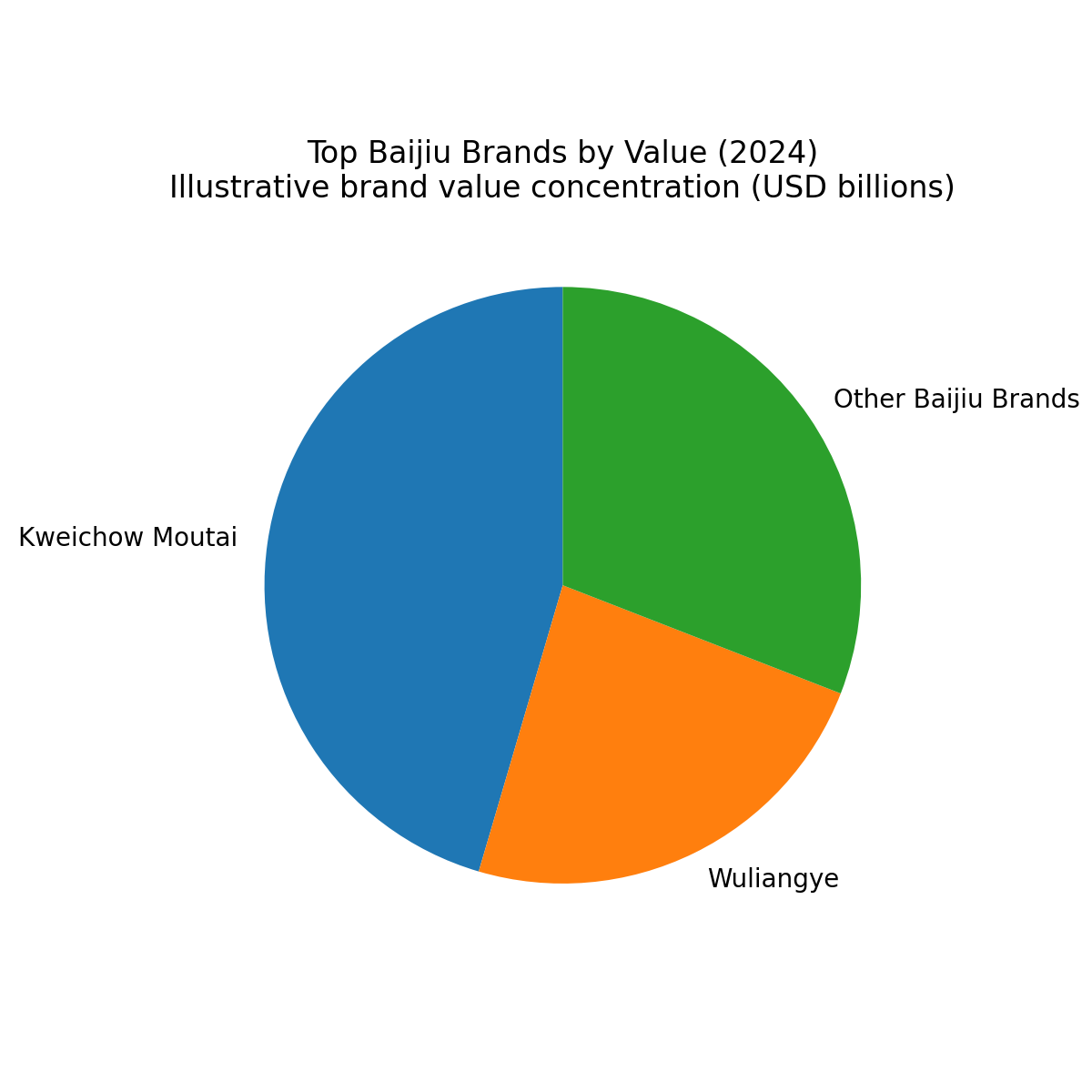
Figure: Top Baijiu Brands by Value (2024). Moutai and Wuliangye far outstrip other brands. Brand Finance values them at ~$50B and $26B respectively. This pie chart (illustrative) highlights that ~70% of the value of Chinese baijiu brands is concentrated in these two giants (pink and blue slices).
Emerging Challengers
In recent years a few craft and corporate newcomers have entered. Jiangxiaobai’s rebranding to Bottle Planet is a prime example: it shifted focus from traditional baijiu to a portfolio of low-alcohol “new drinks” (fruit spirits, plum wine, RTD cocktails) and is actively expanding overseas. Similarly, companies like Niulanshan (Beijing) and local xiao qu micro-distilleries seek niches. However, smaller players face a tough competitive environment: distribution is controlled by the giants and regional loyalties to local brands run deep.
Competition from Other Categories
Baijiu also competes indirectly with whiskey, vodka, wine and domestic spirits. In urban centers, rising-income consumers now have wide choice: imported Scotch/whisky bars and grape wine culture are growing. Reuters notes that Western spirit brands are aggressively targeting affluent Chinese (e.g. Diageo, Pernod Ricard). While baijiu dwarfs these categories today, long-term competition for premium-position drinkers is intensifying. The existing dominance of top baijiu firms makes them vulnerable to shifts: if Moutai or Wuliangye sales stagnate, foreign spirit makers stand ready to fill premium-brand aspirations.
Product Innovation & Brand Marketing
A wave of innovation is reshaping baijiu’s image.
Flavored & Low-ABV Lines
Brands are launching flavored variants and lighter formulas. Grand View cites Wuliangye’s “Crush On” 29% ABV fruit-infused product (2025) as an example targeting millennials. Jiangxiaobai now sells baijiu mixed with plum, honey, and tea flavors. Even traditional distillers are experimenting: there are honey-laged and oaked baijius in development, and Moutai has hinted at a lower-proof line to attract new drinkers. Ready-to-drink (RTD) cocktails made with baijiu (e.g. baijiu mojitos, spritzes) are an emerging category.
Novel Formats
Innovative packaging and delivery formats help modernize the brand. For instance, large baijiu barrel cans and portable sachets have appeared for casual usage. Some companies have developed baijiu “shots” and mixers to blend at home. Convenience stores now stock mini-bottle samplers of premium baijius. These formats acknowledge that younger consumers drink differently than elders.
Collaborations & Sponsorships
To capture attention, baijiu brands are engaging in cross-industry marketing. Wuliangye’s tie-up with FIFA (World Cup) put baijiu on a global stage. Moutai has been a major sponsor of Chinese cultural and business events. Pop-culture tie-ins have emerged: Moutai co-branded a baijiu latte with coffee chain Luckin, a viral stunt. Even video game and anime collaborations have occurred (e.g. special baijiu labels for cartoon anniversaries).
Digital Campaigns
Social media marketing is crucial. Baijiu brands run viral video campaigns on platforms like Douyin and WeChat. They leverage influencers (“Key Opinion Leaders”) to generate buzz around new releases. Virtual reality distillery tours and interactive mini-games on apps are used to engage tech-savvy audiences. During shopping festivals (Singles Day, 618), baijiu companies often livestream from distilleries, offering bundled deals and limited edition gifts (often sold out in minutes).
Success Stories
Two illustrative examples: (a) Luckin Coffee’s Moutai Latte: In 2023, Luckin launched a limited-edition cold brew latte infused with Moutai baijiu. On day one it sold 5.5 million cups (≈$14M revenue), demonstrating baijiu’s novelty appeal. (b) Bottle Planet (Jiangxiaobai): After rebranding, Bottle Planet now exports to 30+ countries and is featured in global fine-dining outlets. Its “Meijian” fruit baijiu line appears in Paris’s Louvre restaurant (indicating a high-end positioning). These cases show that with creative marketing, baijiu can capture new segments.
A tabulation of recent product launches (by category) would show a rising count of flavored baijiu and RTD releases since 2020. Brands are using these campaigns to reframe baijiu as trendy rather than purely traditional.
Market Forecast & Scenario Analysis (to 2026)
Putting it all together, baijiu demand is expected to grow moderately through 2026 under most scenarios. Using 2024 as a baseline, industry forecasts give 5-6% CAGR for baijiu in the mid-term. For example, VMR’s 2026-2032 outlook assumes ~5.3% growth. Grand View projects ~4.0% from 2025-2033. We can therefore model a baseline case of ~4% annual growth globally and ~3.8% in China (their domestic CAGR).
However, outcomes could vary:
- Upside Scenario: If China’s economy remains strong, anti-graft measures ease, and global demand accelerates (e.g. due to a baijiu export boom), growth could reach 5-6% CAGR. In that case China’s baijiu market might reach the high $150-160B range by 2026, while global baijiu exceeds $180B. Premium and export segments would outperform.
- Downside Scenario: Conversely, if consumer austerity tightens or competition bites harder, growth might slow to 2-3%. In this scenario, China’s baijiu market would flatline or grow only to about $150B by 2026, and global totals would be correspondingly lower. Exports might stagnate.
The chart below illustrates these scenarios with best/worst bands around a baseline trend line. (Actual 2023-2024 values are anchored to ~151B global and ~140B China in our model.) All scenarios still show net increases year-on-year; no analysts predict an outright market contraction in this period, given the cultural attachment to baijiu.
Figure: Baijiu Revenue Forecast (2023-2026). This illustrative chart shows a baseline forecast (solid lines) of ~4% annual growth for China (red) and global baijiu (orange), with shaded bands for optimistic (high growth) and pessimistic (low growth) scenarios. Estimates are anchored by industry projections. Even under conservative assumptions, the trend is upward.
Breaking down by segment, domestic premium baijiu is likely to grow fastest (due to reinvigorated gifting and luxury consumption), while economy volumes may saturate. Export volumes, though small, could rise double-digits percentage-wise if market entry succeeds, but will remain a sliver of total.
Strategic Implications and Recommendations
For baijiu brand owners and marketers, the data point to several clear strategies.
Double Down on Premium/Luxury
The premium segment is the bright spot in an otherwise mature market. Brands should focus on high-end positioning - limited editions, aged vintages, collectible packaging - to capture affluent consumers and justify higher margins. Emphasizing heritage and craftsmanship will reinforce the status appeal. Examples: expanding aged-baijiu lines, securing “luxury brand” status (like Moutai’s) through awards, and targeting high-income events (exclusive tastings, gala sponsorships).
Leverage Digital and E‑Commerce
Online platforms are key to future growth. Brands must invest in robust e‑commerce infrastructure (flagship stores on Tmall, JD) and harness livestream sales. Collaborate with influencers and KOLs for product launches. Tailor online content to younger users (short videos, interactive games about baijiu). Use big-data to personalize promotions (e.g. WeChat targeted ads based on age/taste). Also optimize cross-border e‑commerce to reach diaspora: enable shipping through international Tmall or Aliexpress routes.
Expand Export Efforts (Targeted)
Given cultural challenges, exports must be highly targeted. Focus first on Chinese diaspora hubs (HK/Macao/Singapore) and cosmopolitan cities where mixology is popular (NY, LA, Tokyo). Form partnerships with niche importers and duty-free operators. Participate in global spirits competitions and trade shows. Provide education - e.g. train bartenders in baijiu cocktails as CHFT recommends. Consider “localization” strategies: release special-edition baijiu that ties in with local festivals or culinary trends. Lobby for tariff reductions or favorable trade deals in key markets (as China did with HK tax policy).
Innovate Product Lines (Health & Novelty)
Develop healthier and trendier formulations. This means continuing to lower ABV (especially for youth markets) and expanding flavored variants. The success of baijiu lattes and fruit spirits shows openness to fusion drinks. Allocate R&D to “new baijiu” (e.g. lightly-sweetened, easy-to-mix formulas). Also innovate packaging and dosage: smaller bottles, droppers, cans for on-the-go consumption. Be mindful of “mindful drinking” by certifying some products as low-calorie or using healthier ingredients.
Optimize Channel Mix
Despite e-commerce growth, traditional channels remain important in China. Brands should maintain strong relationships with restaurant distributors and banquet caterers, especially for mass-market lines. At the same time, exploit online data to identify underserved regions (e.g. rural western provinces) and target them via rural e-commerce. For exports, use duty-free (airports, cruise ships) and high-end retail, rather than mass retail. Emerging channels like alcohol delivery apps, corporate gifting platforms, and even co-branding with food/beverage chains (like the baijiu latte case) can reach new users.
Protect Brand and Mitigate Risks
Counterfeit protection is vital. Invest in anti-fake labeling (RFID tags, blockchain tracking) to reassure buyers of premium bottles. Diversify risk by not relying solely on government spending - cultivate private gift and retail channels. Closely monitor regulatory changes (anti-corruption policies, export rules) so strategies can adjust quickly. For example, if new export tariffs emerge, pivot more towards domestic e-commerce or duty-free channels.
Each recommendation is grounded in market trends. For instance, the premium focus aligns with the rising ultra-premium segment. E‑commerce emphasis is driven by data showing explosive online sales growth. Export initiatives respond to government targets of expanding overseas sales. And product innovation follows the documented success of flavored/low‑ABV launches. Baijiu companies that act on these strategies will be best positioned to grow through 2026 and beyond.
.svg)